




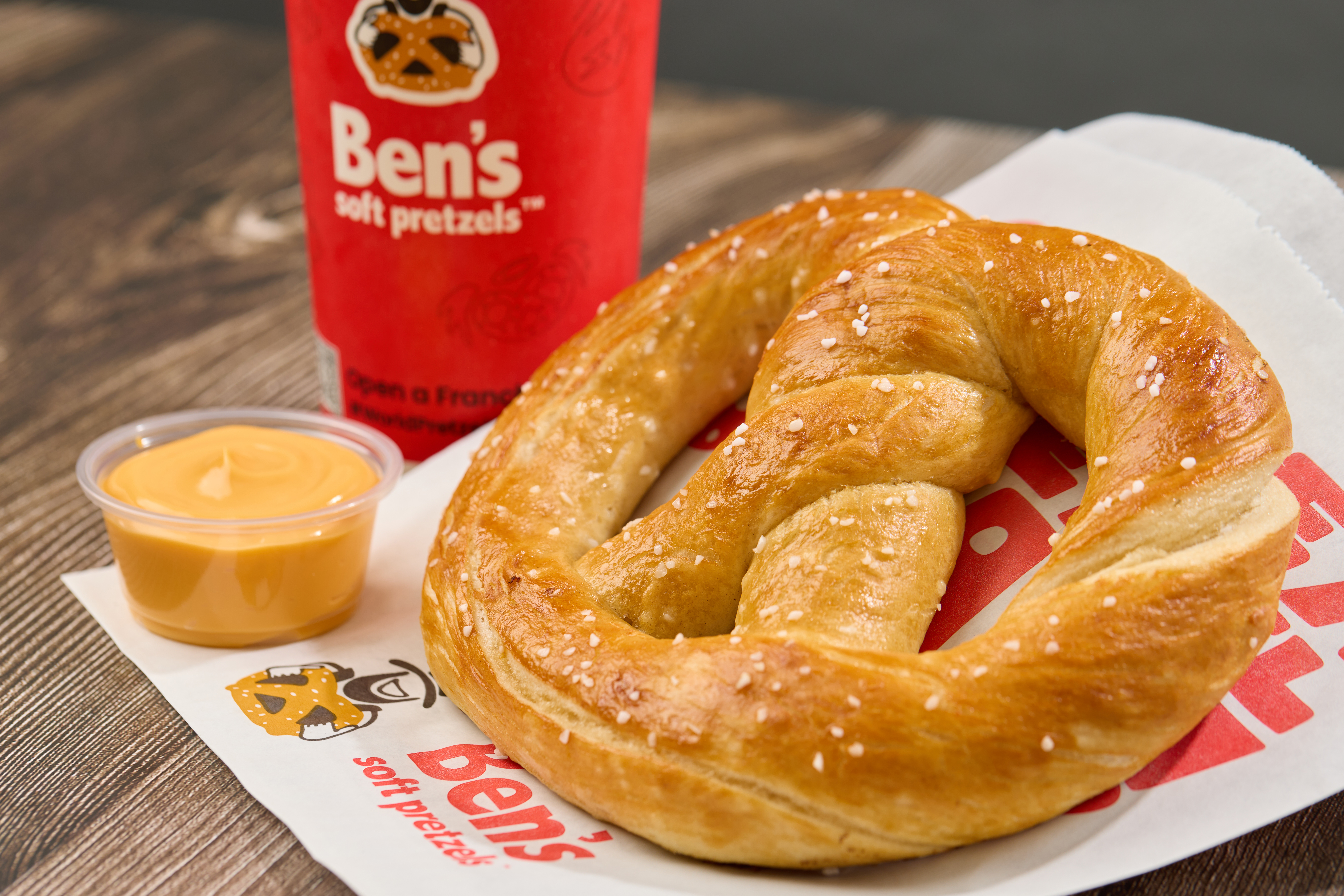
Ben’s Soft Pretzels began in 2008 with a simple mission: to rid the world of inferior pretzels. Founded in Elkhart, Indiana, by Scott Jones, Brian Krider, and baker Benjamin Miller, the company grew from a single mall kiosk into a franchise empire serving fans in more than 100 locations across 17 states.
Their signature recipe, first perfected by Ben and his wife on their Amish homestead, quickly caught the attention of stadiums, universities, and big venues. The first breakthrough came at Notre Dame, thanks to a connection from their now–vice president, Tiffany Watts, who wasn’t yet part of the company but believed the pretzels deserved a bigger stage. The university’s concession team loved the product and invited Ben’s to set up at Irish Green, a new fan area at the time. On game days, their stand drew the longest lines, quickly making Ben’s a favorite among Notre Dame fans. From there, word spread to other universities and eventually NFL and NBA stadiums, cementing Ben’s reputation as the top soft pretzel brand for fans across the country.
As the business scaled from local mall favorite to national franchise, so did the complexity of running it. Managing operations across several locations meant finding a point-of-sale and loyalty platform that could keep pace with their ambitions. That search led them to Square — not once, but multiple times.
While the team explored other providers along the way, the story of Ben’s Soft Pretzels is just as much about growth as it is about coming back to the one partner that consistently delivers on its promises.

The challenge: Finding a POS partner that delivers what it promises
In the early days, Ben’s Soft Pretzels operated with little more than standard cash registers with limited reporting. As the business expanded into franchising, they cycled through a series of point-of-sale systems, always searching for a partner that could handle the unique demands of a national franchise network.
“We put our POS out to bid and looked at five or six different systems,” recalled co-founder Brian Krider. “It actually came down to Square and another company. At the time, the other company just had a little bit more of the franchising model we thought we needed.” So the team chose the competitor.
It didn’t take long for cracks to show. “Halfway through setup, we’d hear, ‘Oh, we can’t actually do that yet’ or ‘That’ll be available in another year,’” Krider explained. “We weren’t going to start a relationship on pretty much a lie.”
Ben’s returned to Square, just as Square launched its franchise program, which proved to be a better match for the brand as it continued to scale.
But a few years later, the brand’s needs changed. The team wanted deeper loyalty and communication features specific to their system, and believing another provider could deliver, they made a switch again. “When we left, it wasn’t because Square was inferior,” Krider noted. “We were like, ‘hey, we love Square, but we need to be able to talk to our consumer in this way.’ And Square didn’t have that option at the time.”
That second switch turned out to be worse than the first. “It was an absolute train wreck nightmare,” he recalled. They realized the new program wasn’t designed for quick-service restaurants and instead pushed features the brand didn’t need. “Our loyalty club members would come in, we’d go through the process of putting in their information, and it wouldn’t pull up our consumer.”

Within weeks, franchisees had lost faith in the new system, and the consistency the brand was known for was suddenly at risk. For Krider and the rest of the leadership team, the stakes couldn’t have been higher: “The restaurant industry is hard enough. We can’t afford to have any hiccups in our POS system or our loyalty system. If I make it more inconvenient for any of my consumers, it only exacerbates the issues we come across on the front lines of our restaurants.”
The solution: Returning to a partner that listens
Ben’s halted the rollout of the new software after it had been implemented in only 10% of their stores and made the call to return to Square for a second time. “We had to make the decision to come back to Square. We could not risk losing more customers to the other system’s ineptness and their inability to get us onboarded and have a product that made sense from day one.”
With franchisee confidence shaken and a clear need to realign their systems, Krider flew to a national restaurant technology conference to broker a meeting with Square and a third-party partner. In less than an hour, the three parties reached an agreement that worked for everyone.
Square’s willingness to adapt and to work with partners rather than force a one-size-fits-all solution restored the team’s confidence. “It did surprise us how hard [Square was] willing to work for us,” says Krider. “We’re not a 3,000-unit system, but they made sure our system was up and running and that we had the truth of what was going on.”
Ben’s Soft Pretzels currently runs on a suite of Square tools across its franchise network, including the fully integrated POS register for payments, marketing automation tools for connecting with customers, Square Online for digital ordering, and shift management software for staff scheduling. More importantly, the system has the flexibility to grow with them.
The impact: Trust, loyalty, and confidence at scale
With Square Loyalty in place across the franchise network, Ben’s is driving more repeat visits and higher ticket sizes, a critical advantage for the high-volume business. “Our loyalty club members spend an average of two or three dollars more per transaction,” says Krider. “It’s one and a half to two times more than a non-loyalty customer. So those things are huge.”
Beyond customer retention, Square is also meeting the high standards Ben’s sets for its franchise POS system. “We put together seven things that we looked for when we went out and looked for a POS provider,” Krider explained. “Number one for us is always the consumer: how the transaction feels, how loyalty works, and how easy online or app ordering is. Next is the franchisee: our operators and what their day-to-day experience looks like running the store. And finally, the back office: reporting, menu changes, and ease of use. Those are the big three, and Square is checking all those boxes 100 percent.”
Looking ahead, the business has big plans, and its journey has only reinforced Square’s reputation as a partner they can count on. “The big thing that I’ve noticed with Square is that the teams I’ve worked with are humble, accommodating, and willing to listen,” Krider said. “Square has been who they said they were going to be and more. That, to me, is worth its weight in gold.”


