





Table of contents
Small businesses are increasingly incorporating artificial intelligence (AI) to unlock efficiencies. Not coincidentally, the higher the revenue a company earns, the more likely it is to employ AI. But small business owners don’t always have the time to research and test emerging technology.
There are two main types of AI that small businesses are exploring today:
- General-purpose, commercial AI tools like OpenAI’s ChatGPT, Anthropic’s Claude, and Google’s Gemini that can be harnessed through thoughtfully designed prompts. These are free with upgrades available with tiered subscriptions.
- Alternatively, AI is often integrated directly into business software. Square AI for instance, lives directly in the Square Dashboard with secure access to your data to help you uncover insights quickly.
Let’s debunk some common myths about small businesses and AI — and when to use which AI tools, for what.

Myth #1: AI is only for big-tech budgets
In a 2025 survey by the Initiative for a Competitive Inner City (ICIC) 89% of small business owners indicated that someone in their business currently uses AI tools.
Not surprisingly, the number of adopters has increased amid the rise of ChatGPT and other commercial AI engines like Claude and Gemini. While commercial platforms have the benefit of being free for basic usage (advanced versions require fees), they’re not directly connected into the business tools you use daily. These commercial AI tools are great for market research, drafting marketing copy, and more. But if you’re looking for insights specific to your business, which can help you optimize sales and inventory, or time-consuming tasks like staff scheduling, then you should look for AI tools integrated directly into the business software you’re already using. For example, businesses that run on Square can chat with a conversational AI assistant directly in their Square Dashboard, Notion AI is integrated into the Notion workspace enabling businesses to simplify project management, or Canva-AI offers AI-powered design tools.
Early adopters are using AI to assist with many previously time-consuming tasks. Entrepreneurs who have integrated these tools into their workstreams are using an average of four AI tools in nearly twenty distinct areas to support their business, according to the Small Business & Entrepreneurship Council’s (SBE) Small Business AI Adoption Survey.
In most cases, AI common use cases include:
- Marketing
- Drafting emails, editing, and general content creation
- Data analysis, market research, and strategic planning
- Employee performance monitoring
Sometimes, AI tools embedded into your business software don’t come at an additional fee at all. Plus, they can actually save you money by saving you time and helping you optimize your operations.
The most important step is understanding the tools available and developing a strategy that makes sense for you and your small business. Beyond cost savings, you will almost certainly find ways to add efficiencies.
Bradley Kaplan, founder and CEO of Lion Cub’s Cookies in Columbus, Ohio, uses Square AI to analyze sales by location. Like any business owner, he values capabilities that let him make the most out of the hours in a day.
The calculation would typically take me 30 minutes with manual reporting and analysis, but with Square AI, it took under five minutes.”
Bradley Kaplanx → Founder and CEO of Lion Cub's Cookies
Myth #2: AI replaces the human touch
Think of AI like the assistant you’ve always wanted. While it handles the mundane yet important day-to-day details, you can focus on what you want to.
Ryan Prellwitz, owner of Vines & Rushes Winery in Ripon, Wisconsin, credits Square AI for allowing him and his wife to evolve and expand their wine and pizza establishment. He uses Square AI to analyze hourly sales, which impacts staffing and food preparation decisions.
“We’re getting to the point where AI can be your accountant, your business advisor, and so much more, freeing you up to spend time on the parts of your business that bring you joy,” he says.
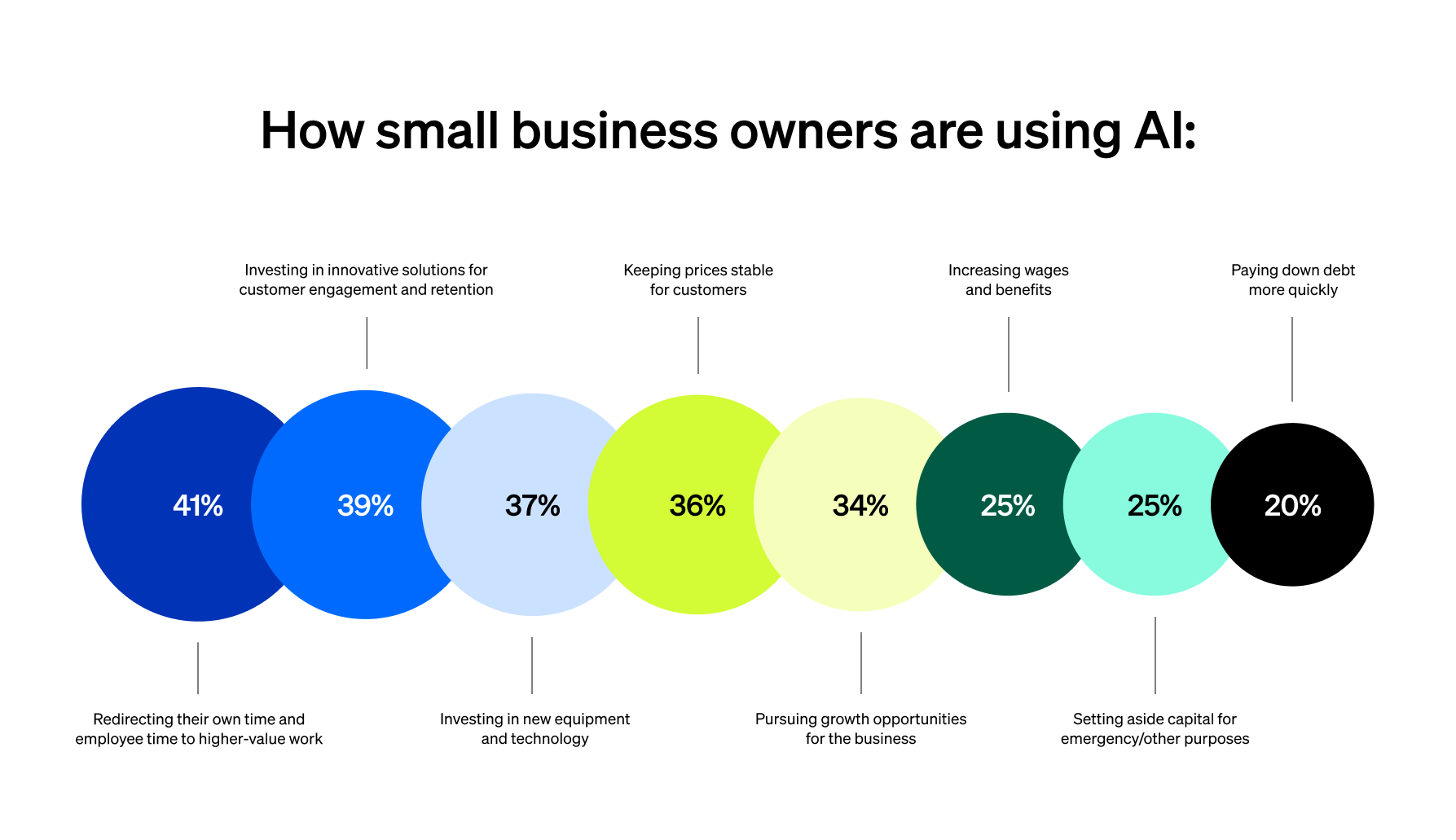
Prellwitz’s sentiment isn’t unique. In the SBE survey, 76% of small business owners reported that AI is freeing both the business owner and their employees of time to focus on high-value tasks.
And while 28% of workers in a Grant Thornton survey expressed fear that their job will be reduced or replaced due to the technology, Square’s data reveals that owners use AI to augment staff, not replace them.
The ICIC report finds more than 60% of business owners who use AI have seen positive changes in employee job satisfaction and productivity.
“When you can get the people on your team empowered to solve a lot of these things that are manual and take up their time, you find that they then have more time to come up with things that really propel the business forward,” notes Cheryl Tisland, founder and owner of Burst Of Butterflies Create & Paint Studio in Chandler, Arizona, who uses Square AI.
AI can also free up employees time to spend on delivering the best possible customer experience. Beyond the meaningful one-on-one interactions between staff and customers, AI derived insights can shed light on small ways to delight loyal customers. For instance, Roaming Goat, a San Francisco wine bar, uses insights from Square to offer a free dish to customers who regularly order digitally, something a human observer may miss.

Myth #3: AI is too complex for non-technical users
The biggest hurdle business owners face with implementing AI is overcoming the initial fear that they won’t understand how to use AI, or that they won’t use it well. The ICIC report noted that almost three-quarters of the business owners who don’t use AI cited a lack of knowledge of new digital tools as a key factor keeping them from adopting AI.
Entrepreneurs can be assured that AI isn’t overwhelming to use. Far from it. All it takes is a few prompts on a free tool like ChatGPT for a novice to see powerful results. Plus, AI tools like Square AI make it easy to ask a question in your natural language and generate a response. Other AI tools are so integrated into your business software, they drive value with just a click.
The user experience (UX) is designed for a range of expertise, so beginners can grow into their reliance on the tool while experienced users can seek solutions to complex questions.
Chip Adkins, co-owner of Piper’s Ice Cream Bar in northern Kentucky, says he uses Square AI to convert data into files he is comfortable using with strong results.
“Square AI gives me customer CSVs in my preferred format, which I download every day and import into an analysis,” Adkins says. “The AI… has streamlined my calculations immensely.”
After developing some confidence with AI, business owners can feel empowered to delegate AI-based tasks to their employees. The ICIC report breaks down which staff are using AI:
- Business owners (41%)
- Higher-level manager (51.4%)
- Mid- and lower-level management (37%)
- Higher-level workers (40%)
- Entry-level workers (28%)
- Interns (15%)
Myth #4: AI will take away my authenticity
Entrepreneurs are naturally going to be protective of their business, including the relationship with valuable customers. That trust is built on authentic experiences and communication.
It is important to remember that AI is a learning tool, meaning it will adapt to your preferences. Business owners can maintain their brand’s voice and integrity by inputting their original content, such as a mission statement and marketing materials, which serve as a guide for the AI to understand their goals and the purpose of each project.
Over time, it has the ability to predict and suggest content and topics business owners can use to maintain their presence in the marketplace. Ultimately, the AI will strengthen entrepreneurs’ brand and deepen existing relationships rather than detract from them.
Square AI can incorporate local factors such as weather and events when analyzing the information. Rather than guessing why a product isn’t attracting customers, the AI provides data-based reports factoring in circumstances the business owner might not have considered.
Based on the AI analysis, owners can freshen menus, offer specials, and adapt offerings to match what customers are seeking.
“Square AI helps me decide which days of the week items sell best — for example what days are the best to run specials,” says Donnie McClanahan, multi-unit manager at Roddy Vending Company in Knoxville, Tennessee. “All that data is in Square. Without Square AI, it’s difficult for me to piece it all together to make informed decisions.”
The data speaks for itself. The SBE survey finds that 93% of small business owners agree that AI tools offer cost-effective solutions that drive savings and improve profitability.

Myth #5: AI puts my data & privacy at risk
It goes without saying that business owners should protect their company’s privacy and that of their customers when using AI.
Some basic cybersecurity steps can go a long way toward minimizing risk:
- Choose trustworthy platforms with a strong track record.
- Include contract language with vendors, partners, and clients about how data can and cannot be used with AI tools.
- Conduct regular data audits.
Interestingly, SBE reports that 32% of small business owners use AI to support their cybersecurity efforts.
The right partnerships with technology partners add layers of protection. Square AI has a multi-faceted approach to data security. Highlights include:
- Zero-day retention policies with any third-party company (OpenAI, Anthropic, etc) prevent personal information from being stored on those platforms or used to train their models.
- Financial data like credit card numbers and account information is never sent to third parties.
These guardrails make it safer for your staff to interact with Square AI than using generative AI platforms like ChatGPT on a personal account while conducting business.
A majority of small business owners who already use AI are streamlining routine tasks to save time, deepening insights to make better business decisions, and driving upticks in team morale and productivity.
Now is the time to free up hours for your passions and build your customer base. Are you ready to start harnessing AI? Log into the Square Dashboard and click the Square AI icon to get started.