






Table of contents
In a busy neighborhood, the same faces turn up in more than one business’s day. A regular might start the morning at a local cafe, head to an appointment, browse a nearby store, then pick up flowers on the way home. Each transaction happens separately, but together, they trace a network of businesses connected by the customers they share.
The 2026 Square Local Economy Report found that businesses in the same ZIP code share an average of 32% of their regular customers. Drawing on Square’s business and consumer transaction data, the report defines a regular customer as someone who has purchased from the same business on at least four separate days within a one-year period, and a shared-customer connection as two businesses sharing at least one regular customer.
The data shows that as people return to the businesses they love, they also tend to visit other businesses nearby.
This is the Neighborhood Network Effect: the idea that businesses linked by the same regular customers can reinforce one another. When customers spend locally, more businesses draw on the same pool of loyal shoppers.
Shared customers track with higher revenue
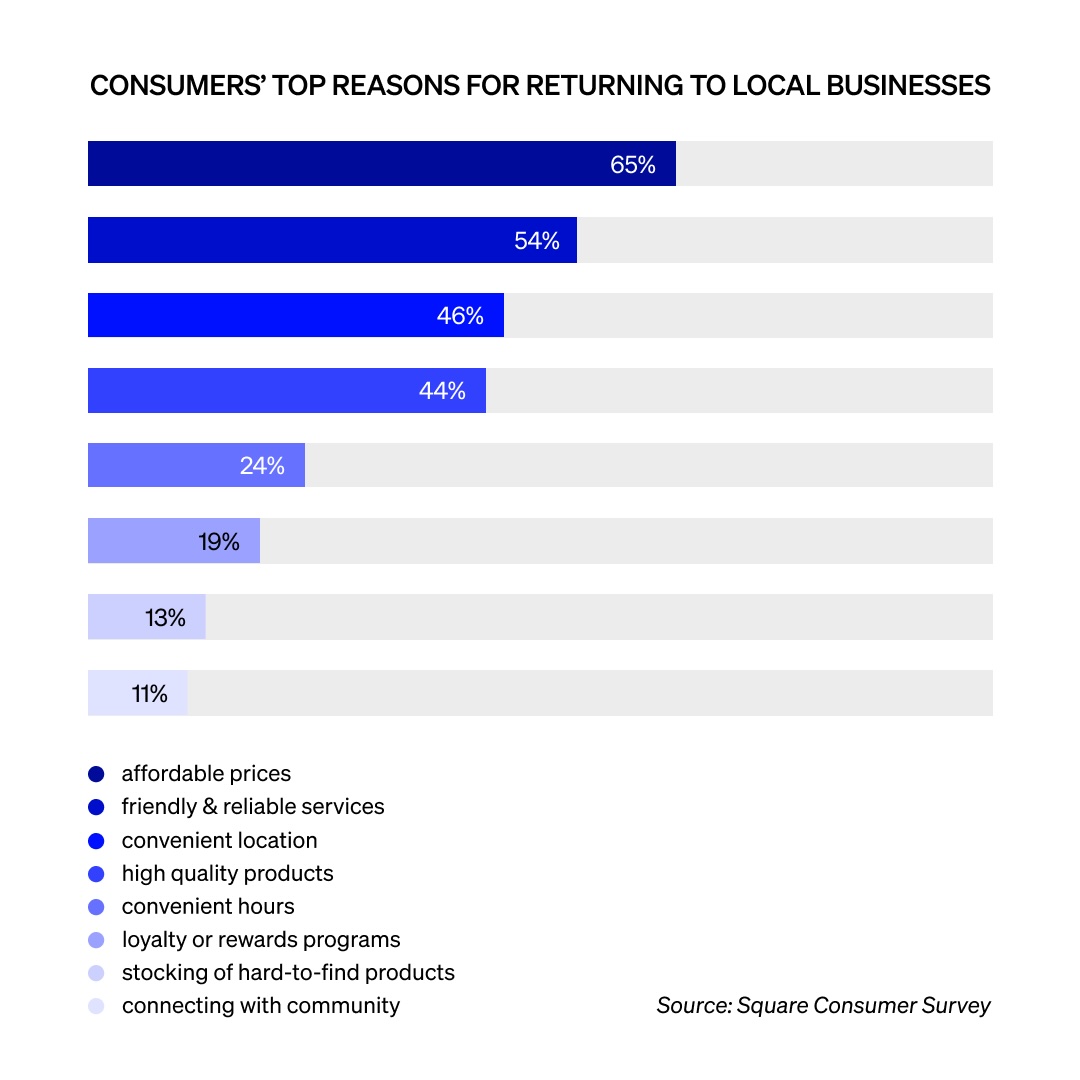
According to the report, roughly half of consumers surveyed said they make purchases at local retailers and restaurants in their ZIP codes several times a week. Those frequent visits mean customers naturally build routines around their neighborhood, and businesses become connected through the regular customers they share. As those networks grow, so does the potential for greater business impact across an entire area.
Square found that U.S. businesses with more shared-customer connections typically generate higher annual revenue. In Los Angeles, each additional network connection was associated with an average of $2,201 more in annual revenue. Chicago, New York, and San Francisco showed a similar pattern, with every extra connection linked to $1,100 to $2,025 in additional annual revenue.
These networks also extend across industries. In San Francisco’s Richmond neighborhood (94121), a path of shared regular customers links a hair salon with a nearby coffee shop, which then links to a dessert shop. Another chain of shared regulars in River North, Chicago (60654), stretches from beauty businesses to a casual restaurant and a physical therapist.
The businesses themselves may be very different, but they’re often part of the same customer journey, helping keep spending circulating through the neighborhood.
“Neighborhoods aren’t just a collection of individual businesses; they’re interconnected networks where success is shared,” said Nick Molnar, Global Head of Sales and Marketing at Block, Square’s parent company. “When a coffee shop thrives, the salon next door benefits. When regulars support one business, they’re often supporting five others in the same ZIP code.”
Coffee shops are natural neighborhood connectors
In every city analyzed, coffee shops were among the businesses sharing the most regular customers with their neighbors.
Someone grabbing a coffee might also pick up groceries, stop at the pharmacy, or get a haircut while they’re out. Because coffee shops are such a regular stop in many people’s day, that foot traffic also naturally flows through to neighboring businesses.
“Regulars are massively important,” said Alan Morales, co-owner of Civil Coffee in Los Angeles, who says the shop’s regulars often come in three to five times a week. “Regulars spend so much more, even if it’s just once a week.”
How businesses are building these connections
Some operators are building their neighborhood network connections deliberately.
Independent bookstore Green Apple Books opened a pop-up inside Devil’s Teeth Baking Company, giving the business a presence in a San Francisco area that didn’t have a dedicated bookstore. The partnership introduces the bookstore to customers who may not have discovered it otherwise, while giving bakery customers another reason to explore the space. Visitors stopping in can discover a new business, and not long after, “they come checking on one of our other stores,” said Green Apple Books co-owner Pete Mulvihill.
Civil Coffee hosts block parties with neighboring businesses in Highland Park, Los Angeles, including a clothing store, bar, and bowling alley. Customers are encouraged to explore more of the area by receiving rewards at every participating stop they visit.
“We see a peak of sales because [customers] come out for that activation,” said Morales. “But it’s more about making sure you’re capturing their attention constantly in a world where there’s always something else opening up.”
Quick-service restaurant NaanStop in Atlanta regularly participates in fundraiser events, often supporting two to three pop-ups every week. As the restaurant became more visible, more invitations followed.
Owner Neal Idnani said, “Once people saw us in their communities, they started saying, ‘We’ve got a 5K happening this weekend, can you come and do a presence?’ or ‘We’ve got an art gallery that’s holding a fundraiser for this other organization. Can you come over here?’”
Each local choice adds up
Local economies are shaped by the everyday interactions that bring customers and businesses together. The way people move through their local area — from weekly routines to unexpected discoveries — influences the businesses that become part of their lives.
That makes proximity itself an asset. “The businesses that will define the next era of local commerce aren’t just focused on their own four walls,” Molnar said. “They’re tapped into the rhythms of their community, deeply connected to their regulars, and showing up how it matters most: with ease, convenience, and in-person expertise.”


