




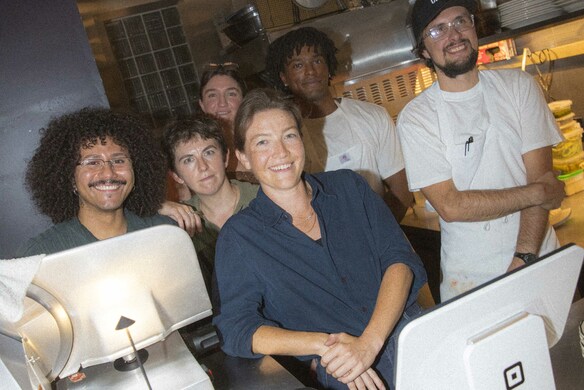


“Stir Crazy is a feeling,” says Mackenzie Hoffman, co-owner and operator of Stir Crazy, a neighborhood wine restaurant on Melrose Avenue in Los Angeles.
Hoffman and co-owners Harley Wertheimer and Macklin Casnoff, as the Los Angeles Times reported, took over a decades-old coffeehouse called Stir Crazy and kept the name. They reopened it as a restaurant in May 2023, according to Air Mail. “We chose to stick with Stir Crazy as our name, simply because we didn’t want to be an imposition on the neighborhood,” Hoffman explains. “We really wanted to just flow right in and serve the neighborhood.”
It’s her first restaurant as an owner, though far from her first shift. “I’m obsessed with restaurants… that comes from 15 plus years of working in both New York City and LA,” she says.
Stir Crazy operates out of a 500-square-foot space, with a team of eight and a wine list featuring hundreds of selections. Open Monday through Friday, it earned a spot on the LA Times 101 Best Restaurants list in 2024 and was featured in Wine Enthusiast’s 2026 guide to LA’s best wine bars. Regulars also book the space for weddings, baby showers, and birthdays.
That room can’t grow, so growth has to come from each visit. Making that work takes Square POS for restaurants running hard behind the scenes, where guests never notice it.
The challenge: Growing a tiny restaurant without adding seats or screens
Margins are thin across the industry. According to the National Restaurant Association, 42% of operators said their restaurant wasn’t profitable in 2025. Hoffman chooses partners with that math in mind, the same way operators rethink restaurant procurement and ordering to protect margins.
“When margins are already so tight, I look to partner with companies, vendors that are thoughtful about my bottom line and offer resources and technologies that I can use… while I’m not stressed about how to pay for them,” she says. “I started with Square because of the value.”
Adding seats isn’t an option. Private events bring in a big share of revenue, so they need their own tracking. The guest experience stays deliberately old-school, too. “Stir Crazy is a very low-fi analog restaurant. We want to be stuck in a certain time,” Hoffman says.
She also wears many hats and works mostly from home, so she needs answers from off-site. And when the Wi-Fi goes out, service hits one of its most stressful moments.
In a room this small, a missed reorder, a mixed-up ticket or a frozen card reader costs real money.
The solution: Using Square POS for restaurants behind the scenes
Hoffman runs Stir Crazy on Square for Restaurants, with the POS kept out of guests’ sight. She uses Square Invoices for private events and keeps backup Square devices ready for outages. “In reality, I use Square the most for its reporting capabilities and then also the invoicing capabilities,” she says.
How much house white sold last night? Hoffman checks reporting from home and reorders. “I can simply use the reporting and not be on site and count the rest of the bottles,” she says. It’s the idea behind reordering with connected inventory data.
Custom modifiers do quiet work on the check. Servers can tack on an extra oyster for $5.25 or ring in a pour by the glass with a button labeled “BTG or half BTG.” Hoffman tracks guest check averages in reporting.
For events, “I have built out an entire event item section that hits my P&L separately,” she says, giving her “absolute control” over event revenue.
Servers memorize or write down orders and repeat them back to guests. “The kitchen ticket prints at the POS and the server has to give it to Expo. And that’s a forced contact between server and Expo,” Hoffman says.
That analog streak reaches the receipt, too. “We even have a political cartoon on our receipt,” she says. For her, the tech can move forward while the room stays put: “Square is pushing the envelope forward with technology such as Managerbot. It also allows me to keep all of that.”
When the Wi-Fi drops, she pulls out backup Square devices and keeps taking payments through offline credit card processing. Those payments should be uploaded within 24 hours, and she’s responsible for any that are declined or expire. “I’m confident that orders are still being placed, payments are still being captured, and most importantly, my team isn’t feeling down and out because of something outside of their control.”
Square enables me to work on the business and not in the business by helping me generate exactly the reports that I need. I always know what’s going on in the business, even if I’m not there.”
Mackenzie Hoffman → Co-owner, Stir Crazy
Impact: Growing guest spend from $65 to nearly $100 a head
When Stir Crazy opened, guests spent about $65 per head. Today, they spend close to $100. “We want less people spending more money. And Square has helped me track that through the past three years,” Hoffman says.
Small add-ons matter here. By her estimate, even a small increase in what each guest spends could add up to a meaningful boost in earnings for her team. The ticket handoff pays off, too, with “close to zero order inaccuracies” and little waste.
Her team has access to sales, item mix and revenue, though not the financials. “Simply by giving them access to Square reporting, I can have a stronger, faster, better, more supported team,” she says. “If a kitchen teammate puts a dish on the menu, they can actually see the mix and how it’s selling week after week after week.”
That shared data supports making good decisions as a team and shows up in how she attracts and retains staff.
“They’re empowered, and my team is empowered…” Hoffman says. As for what’s next, she thinks about scale as “more smaller restaurants,” a path laid out in Restaurant 201’s guide to scaling up.


