




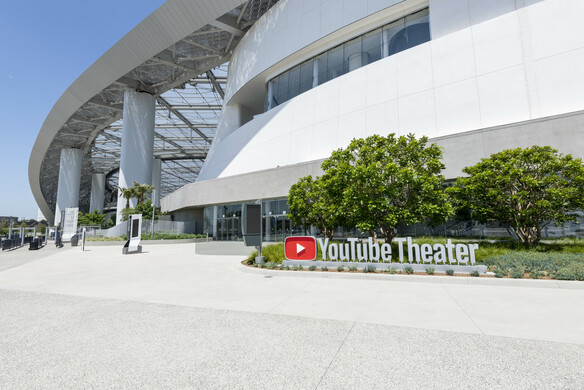


YouTube Theater was built to make live entertainment feel more intimate. Behind the scenes, Square helps the 6,000-seat venue handle thousands of transactions in a narrow pre-show window, adapt operations to different audiences, and keep guests focused on the performance.
When YouTube Theater was conceived, the idea was to create something different from the massive scale of the 70,000-seat SoFi Stadium next door. The theater was designed to give thousands of fans a more intimate connection to the performance.
Located at Hollywood Park in Inglewood, California, under the same roof canopy as SoFi Stadium, the 6,000-seat venue hosts everything from K-pop and rock shows to comedy, live podcasts, Latin regional performances, and legacy acts. Its fan-shaped seating bowl, advanced acoustics, and flexible production setup were designed to give guests a close connection to the performance, no matter where they sit.
“There’s not a bad seat in the house,” said Andrey Tolmachyov, General Manager of Legends Global at YouTube Theater. “You can see the show from anywhere and feel the performance.”
That attention to the guest experience extends beyond the stage. On a typical event night, thousands of people move through concessions and merchandise stands in a narrow window before the show begins.
Since opening in 2021, YouTube Theater has welcomed nearly 2 million guests and hosted major concerts and events, including Pitbull, H.E.R., Bon Iver, and the 2022 NFL Honors during Super Bowl week. Because the calendar can change dramatically from one night to the next, the venue has to be just as flexible behind the scenes as it is onstage.
“We have a lot of diverse events, and we sometimes have to pivot quickly from one event to another,” Tolmachyov said. Whatever the event, the goal is the same: move guests through efficiently so they can get to the show.
In that environment, even small delays can affect the guest experience. More time waiting for food, drinks, or merchandise means less time enjoying the experience the venue was built to deliver.
The challenge: Serving thousands of guests before showtime
For YouTube Theater, the biggest operational challenge is time.
Once doors open, guests may have only about an hour before showtime. In that window, thousands of people are buying food, drinks, and merchandise before heading to their seats.
“We have a very compact time window to serve our guests before the show begins,” Tolmachyov said. “They want to get in their seats as soon as possible.”
With so many guests moving through in such a short period, long lines, slow payments, or technical issues can quickly eat into the experience they came for.
“Speed and reliability are the biggest priorities,” Tolmachyov said. Delays at concessions, merchandise stands, or the point of sale can keep guests from getting to the show.
The challenge also changes from event to event. YouTube Theater’s diverse calendar means the team may need to rethink what it sells and how the point of sale setup is configured from one night to the next.
“Let’s say we had a metal show one day and we’re switching to a K-pop show the next day,” Tolmachyov explained. “Sometimes the product mix or the favorite section needs to be edited.”
The venue needed a system that could support the way YouTube Theater operates. It had to be fast enough for the rush before showtime, reliable enough for a live event, and flexible enough to adapt from one crowd to the next.
Those requirements shaped the way YouTube Theater set up its operations from the start.
The solution: A flexible system that can change with the show
YouTube Theater chose Square because speed, reliability, and flexibility were essential to its event-day operations. Square gives the team a point of sale (POS) system it can configure around the needs of each event.
Managers can prepare the system in advance based on what the venue expects to sell, update menus and favorite sections on the back end, and move portable devices like the Square Handheld and Terminals wherever demand is expected to be highest.
“Depending on different events, different configurations of food and beverage and merchandise, we adapt based on the event, based on what demographic is coming in, and we shuffle things around,” Tolmachyov said. “Having portable devices is very important.”
The system also needs to stay simple for the people using it. Tolmachyov said YouTube Theater can customize its setup in a way that is “easy for employees to learn, easy for employees to use, and easy for employees to work.”
Square gives the management and operations team access to live sales data during events, helping them spot trends and make adjustments on the fly. Behind the scenes, Square APIs connect sales data with YouTube Theater’s Yellow Dog inventory management system, giving the team a clearer view of inventory levels and cost of goods sold (COGS).
“The ability to link Square’s sales and Square’s data with our inventory systems help us manage our COGS really well,” Tolmachyov said. “It really creates a faster and less friction environment for workflows, menu control, inventory levels.”
The impact: Keeping guests focused on the show
On a typical event day, YouTube Theater processes about 2,500 transactions across roughly 38 Square devices, or around 70 transactions per device. At that scale, keeping each interaction simple can make a meaningful difference for guests trying to get to their seats.
Tolmachyov pointed to refunds as one example. If someone is charged for the wrong item, double charged, or otherwise needs a transaction corrected, staff can resolve the issue on the Square device in front of them.
“The guests see that the issue is resolved, so they can exhale,” Tolmachyov explained. “They don’t need to worry about anything anymore, and then they can go and enjoy the show.”
For the team behind the scenes, live sales data means managers can see what is happening during an event and respond while there is still time to make a difference. Together, those capabilities help keep the operational side of the venue from distracting from the experience it was built to deliver.
When transactions and day-to-day operations stay in the background, the venue can keep its guests’ attention where it belongs: on the show.


