




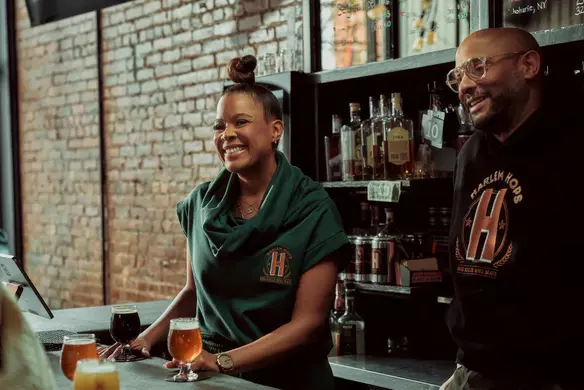


Harlem Hops is the first 100% Black-owned craft beer bar in Harlem. Driven by the goal to create community and return Harlem to its pre-Prohibition legacy as a brewing mecca, the business is deeply rooted in authenticity. Founded by Kim Harris, Kevin Bradford, and Stacey Lee Spratt, three graduates from Historically Black Colleges and Universities (HBCUs), the brewery prioritizes small, local, Black-owned beer brands — even turning down various partnerships from liquor brands that do not align with their cultural values.
“We don’t want to participate in things that don’t offer genuine engagement or investment in our communities,” Harris said. That foundation is the lifeblood of Harlem Hops. During the pandemic, the business started a nonprofit that helped pay the rent of businesses throughout Harlem and helped college students stuck in the area return home. “It’s beautiful, what we’ve built. The community supports us, and we support the community,” said Spratt.
The business needed tools that kept community at the center of its operations while simplifying challenges like managing cash flow. At the same time, the founding team, who were still working full-time jobs, needed easy access to the tools and insights required to run the business effectively.
The challenge: Bootstrapping with a distributed team
The business faced a host of financial road blocks in its early days. The team struggled to secure bank financing, leading them to bet on themselves and self-fund the business. “We literally did it from working, and continuing to work even after we opened was very important,” said Pratt. But jumpstarting a business with three partners still working full-time jobs added its own complications. Bradford works as a math teacher and Pratt resides in Atlanta, so they knew they needed deep flexibility without constant on-site oversight to succeed.
The team was also witnessing high staff turnover in New York, so they needed tools that helped keep the business on track in a timely manner to keep staff satisfied. “Making sure payroll, vendors, rent, and inventory were all covered while still running a hospitality business were the biggest stressors before we really tightened up our cash flow systems,” Pratt explained.
The solution: A centralized system powered by Square that supports bar growth, staff satisfaction, and remote operations
The business chose Square to power its operations. “We chose Square after serious deliberation with various POS companies,” said Pratt. “As first-time hospitality operators, we needed a system that was easy to learn and train our staff.” More than seven years later, the business still relies on Square.
What’s kept us with Square is how it’s grown along with us. As our business developed with multiple locations and higher volumes, Square met us where we were. Having POS, payroll, inventory and reporting in one place made scaling easier.”
Stacey Lee Spratt → co-owner of Harlem Hops
The tools cater to the team’s unique needs, enabling seamless, smooth operations. All three of the founding partners can toggle between the Harlem and Chelsea locations from wherever they are and “put out small fires remotely.” For day-to-day simplicity, Bradford is able to update keg inventory from his phone between his first and third period math classes.
Pratt is able to effectively handle payroll through Square Payroll from Atlanta, ensuring staff is paid accurately and on time. Tools like Square Shifts and Square Staff provide scheduling transparency and flexibility, allowing staff to easily request time off or swap shifts directly from the app, adding to staff satisfaction.

Harlem Hops is also able to navigate surprise challenges with ease by using Square Instant Transfers. “Having instant access to funds has been the difference between reacting and staying ahead,” said Pratt. “There have been moments where same-day access allowed us to cover an unexpected expense like broken equipment or low inventory without scrambling, delaying payroll, or compromising service.”
70-75%
of sales come from repeat, loyal customers
Impact: Data-driven operations that strengthen customer loyalty and neighborhood ties
Smooth and efficient operations have led to the business cultivating deep loyalty among regular customers. Bradford estimates that 70%-75% of sales come from repeat, loyal customers. The team is able to build on this by using customer insights through Square Dashboard to curate the tap list. “Our customer Shannon loves regular fruited sours but isn’t crazy about heavy fruited smoothie sours. So, I ordered less heavy fruited smoothie sours and more of the regular fruited sours on the latest release,” Bradford explained.

“Another customer, Ché wants to see more Imperial Pastry Stouts on tap line three, so I ordered two kegs of Imperial Pastry Stouts…This lets the customer know we’re ordering with them in mind.” Bradford added that they sometimes take regulars on field trips to local breweries and throw customer appreciation events just to say ‘thank you.’ “We wouldn’t be here without Harlem,” he said.
Unified, data-driven tools have helped Harlem Hops evolve the business into a “data driven hospitality ecosystem that’s deeply rooted in community.” Harris noted that as the business participates in more community events and scales, the team wants every touchpoint to feel seamless and intentional.
“Square makes this possible by allowing us to keep everything in one place. Having POS, HR, loyalty, and online sales connected helps us better understand our clientele, operate efficiently across locations and make proper decisions as we scale,” Harris explained. “It allows us to grow without losing the neighborhood-first, culture-driven identity we were built on.”
Bradford echoed this saying: “Square has been solid with us from day one and kept up as we added locations, loyalty and merchandise. We spend less time worrying about tech and more time focusing on our community.”


