




Table of contents
A point-of-sale (POS) – sometimes called a point of purchase – is where you process sales for customers and accept payments. It’s the backbone of your operations, so when choosing the best point-of-sale system for your small business, start by considering the essential tools and features you need.
As a minimum, you want a POS system that allows you to process every sale securely and quickly. After that, you need software that helps you manage administrative tasks as efficiently as possible. As your business grows, you’ll want a point-of-sale system with tools, features and integrations that help your business scale.
Of course, the kinds of sales you make and the tasks you need help with depend on your business type. A busy restaurant might have different needs to a clothing boutique, and a small business POS system that works for a plumber might not make sense for a hair salon.
So how do you choose? Read on to learn exactly what to look for in a POS system, how to choose one that will work for your business, and the best POS systems available – including their unique offerings.

When do you need a POS system?
A POS system is critical to business operations, no matter what type or size your business is. If you want to accept credit, debit and mobile wallet payments, have a streamlined system for tracking sales, and sell quickly while staying organised, a POS system is essential.
As a refresher, a good POS system can:
- Eliminate manual sales tracking and automate your sales and inventory management
- Connect all of your sales channels, including in-store, online, social media and wherever else you do business
- Accept the payment types that are most convenient for your customers, like card, Apple Pay and Clearpay
- Help manage your team, from creating schedules to automating payroll
- Track your customer data and make it easy to see purchase history and customer information
- Make your marketing simpler with customer segmentation and automated marketing tools
Essential POS features to consider
Before choosing the right POS system, review the key features and costs that can impact your day-to-day operations, cost of doing business, and long-term growth.
As you explore POS systems, consider:
- Initial setup cost: This includes the cost of your point-of-sale system hardware, plus any installation or setup costs associated with it. Keep in mind that if you purchase complex hardware, it may require professional installation. The simpler the installation and setup of your POS, the better.
- Payment processing costs: These are the fees charged when you accept credit card, debit card or digital wallet payments. These can come in the form of flat-rate fees (one fixed rate for all transactions), interchange fees (fees set by the credit card networks) and tiered pricing fees (where transactions are grouped into categories). In general, flat-rate fees tend to be the best for small businesses as they offer simplicity and predictable costs.
- Monthly processing fees: Be aware of any recurring costs charged by POS providers. These can include PCI-compliance fees, software fees, service fees and more. These fees add up, so do your research and make sure you’re investing in a transparent system, ideally one without any monthly fees or PCI-compliance charges.
- Chargeback fees: Chargeback fees occur when a customer disputes a charge from your business and asks their credit card issuer to reverse it. Chargebacks happen, so look for a POS provider that covers those fees for you.
- Equipment fees and rental fees: These fees can eat into your monthly budget, so be sure you understand if there are any ongoing equipment fees associated with a POS system. Some POS providers allow you to rent equipment, but it’s smart to make sure that a rental isn’t bundled with a long-term contract. And of course, do the maths and make sure you won’t be paying more in the long term by renting versus buying outright.

How to choose a POS system
Now that we’ve covered costs and fees, let’s explore the features that matter most.
Ease of use and functionality
A POS system with an intuitive interface reduces training time and ensures staff can confidently and efficiently navigate your system, even during peak windows with high transaction volume. Depending on the type of business you run, look for a point-of-sale system that offers the hardware you need – like a handheld POS for a busy restaurant or mobile business, a stationary POS unit for counter checkout, or even a small POS contactless card reader for an on-the-go operation.
Payment processing flexibility
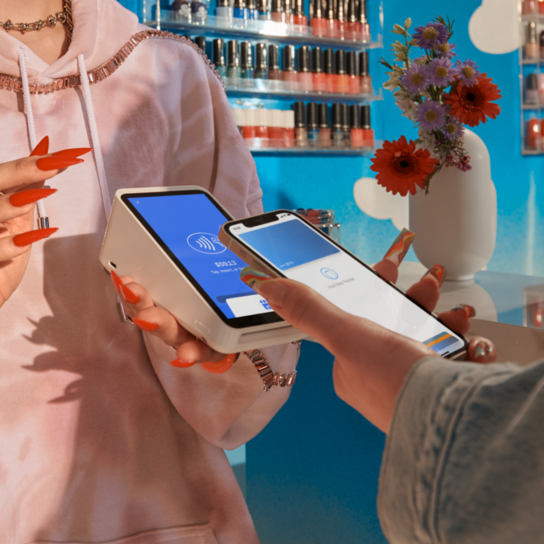
Your system’s ability to handle diverse payment methods is key. Traditional credit cards are a must, but mobile wallets, contactless payments and even buy-now, pay-later payment methods have become commonplace. Being able to pay in a way that’s convenient for customers directly affects satisfaction levels and checkout speed.
Software features
The core functionalities of your POS should address your industry-specific needs, such as inventory management for retailers, floor planning for restaurants or appointment scheduling for service-based businesses. And regardless of your business type, analytics and reporting capabilities are a must-have in a POS, as they provide valuable insights into sales patterns and help you make smarter business decisions.
Sales channels and locations
Your POS should seamlessly manage sales across platforms and locations. If you have more than one location (or plan to), your POS should be able to show you exactly what’s happening at each location, even if you’re not physically there. Your POS should also track sales through your online store, social channels, in-person and any other way you sell, so you can get a holistic picture of your sales in one place.
Integration options
An effective POS system will seamlessly connect with your existing business tools, from accounting programmes to eCommerce platforms. These integrations eliminate redundant data entry and create a cohesive operational ecosystem across all the tools you use.
Scalability
As your business grows, your POS system should be able to effortlessly accommodate additional locations, users and transaction volumes. Make sure you have the ability to easily add new hardware, features and capabilities over time to ensure your POS system will support your business growth, not hinder it.
Security and compliance
Protecting customer payment data through tokenisation and PCI compliance isn’t just good practice, it’s essential for maintaining trust and avoiding costly breaches. Your chosen system should offer proactive fraud protection, account protection, and more.
Offline sales
If your POS system connects to the internet, which most modern POS systems do, make sure your system has an offline mode. This feature is essential in the event of an internet or system outage, and is especially useful if you take payments in places with no internet connection. With offline payments, you can keep accepting payments without interruption.
Employee management features
As your team grows, employee and team management features that are built-in to your POS can help you optimise labour costs and save time. Time tracking, shift scheduling, automated timecards and even features like shift swapping can streamline staff management and communication while empowering your team.
Loyalty programme and marketing automations
Built-in capabilities for customer rewards and engagement programmes can help build repeat business and increase customer lifetime value. The option for automated marketing capabilities can help you grow your customer base and sales even further, especially if your team is lean with limited time to spend on marketing campaigns.
Best POS system for small businesses
Here’s a breakdown of the top point-of-sale systems and what they offer.
| Square | Clover | Toast | Shopify POS | Lightspeed | |
| Monthly POS fees | £0 with free plan, ideal for small businesses. £29+/month for Square Plus. Custom plans available. | Ranges from £1/month to £39.95 for a fully integrated system. | £80/month for the Starter plan, £150/month for the Essentials plan. . Custom plans available. | Ranges from £5/month for selling on social to £344+/month for advanced tools for selling in-person and online. |
Ranges from £75 for the Basic plan to £189/month for advanced customisation and scalability. |
| Software features | Appointments, invoices, eCommerce, custom retail/restaurant POS systems | Standard features geared toward retail and food service | Food service-focused features | Built for omnichannel retail | In-depth inventory management tools |
| Omnichannel sales | Strong all-around: POS + online store, sync’d inventory | Moderate | Limited | Strong for eCommerce and retail | Strong for multi-location retail |
| Third-party integrations | Yes | Yes | Fewer | Yes, in Shopify App Store | Yes |
| Offline sales capabilities | Yes | Limited depending on setup | Yes | Limited offline use | Yes |
| Employee management features | Yes, including payroll features | Yes, including payroll features | Yes, but no native payroll included | Via third-party apps only. No native payroll | Yes, but no native payroll included |
| Loyalty programmes and marketing automations | Yes, native in Square ecosystem | Yes, basic tools via Clover Dashboard | Yes, requires premium plan | Yes, Shopify Email and Marketing Automation, with more advanced tools available | Basic email functionality; requires apps like Mailchimp for email campaigns. |
According to Nerdwallet, Square wins for “Best Overall POS System” in their ranking of best POS systems for small businesses, and Forbes ranks Square as “Best for businesses on a budget” in their comparison of best POS systems for small businesses.
Best POS system for retail, restaurants, services and beauty businesses
Every business has different needs, so you’ll want a POS that offers the right tools and capabilities that you require to operate and grow. Square POS software can be personalised for any business type, ensuring you have the features you need from day one.
Best POS system for retail businesses

Retail stores need a POS with inventory management and hardware compatibility. Square’s retail POS connects with barcode scanners and receipt printers, plus includes built-in email marketing tools. Selling online? Square’s eCommerce features offer secure payments, risk management and seamless integration to sync online and in-store inventory.
Learn more about how to choose the best POS system for your retail business.
Best POS system for bars and restaurants

Bars and restaurants need POS systems with features like menu editing, kitchen communication, ticket splitting and open tabs. Square for Restaurants offers all this – plus tipping and integration with apps like OpenTable and KioskBuddy. It’s simple to set up with affordable hardware kits, like Square Handheld, for easy tableside orders.
Visit our Square Point of Sale demo page to see how we make running a restaurant easier, and learn more about how to choose the best POS system for your restaurant.
Best POS system for contractors and home repair

For mobile businesses, Square offers portable POS options like Square Reader, Square Handheld, and Square Terminal to take secure payments anywhere – even offline. Use Square Contracts to collect payments or deposits instantly, or send professional invoices with Square Invoices for just 1.75% per in-person payment and 2.5% per online payment.
Best POS system for hair, nail and beauty business

Square Appointments simplifies scheduling, payments and services with a free 24/7 booking website. Clients can book any team member or service at any location, with automatic room and station assignments. The appointments POS also supports class bookings and accepts all major payments, including Clearpay for instalment options – ideal for younger clients who want to break up pricier services.
Learn more about how to choose the best POS for your beauty business.
Frequently asked questions about small business POS systems
1. Do I need to pay a monthly fee for POS software or to use a POS system?
Not necessarily. Square offers POS software for free, with the option to upgrade to paid features as your business grows. Some other providers operate on a monthly subscription model. Be sure to check what’s included in each plan to ensure you’re getting the best value for your business.
2. How does a POS payment work?
A point-of-sale payment works by capturing, processing and completing a transaction when a customer makes a purchase. First, the purchase is initiated when the business scans or enters the purchase details into their POS system. Then, the customer pays and the payment is authorised by the payment processor contacting the cardholder’s bank. If the transaction is approved, it’s sent back in seconds and the transaction is complete.
From here, a receipt is generated. Later on, typically at the end of the day, the transactions are settled and funds are transferred from the customer’s bank to the merchant’s account, minus any processing fees.

3. What are the four main types of POS systems?
The four main types of POS systems are:
- Terminal POS systems: These are usually traditional countertop POS systems, like the Square Register and Square Stand.
- Mobile POS systems: Either smartphone or tablet-based POS systems that you can take on the go, like Square Reader, Square Handheld or Square Terminal.
- Self-service kiosk POS: Touchscreen systems where customers can place their own order, such as the Square Kiosk.
- Cloud-based POS: This means a POS system is hosted online, compared to an on-premise POS where data is hosted locally (ie a computer or server). Most modern POS systems, including Square, are cloud-based, which offers remote management and lower setup costs.
4. What are the alternatives to a POS system?
If you feel you don’t need a point of sale for your small business, but still want to securely accept credit cards, there is an alternative solution.
Square Invoices lets you easily send invoices through the free Square POS app. It’s free to send; you just pay 1.75% per in-person payment and 2.5% per online payment. For ongoing services like weekly or monthly billing, you can set up recurring invoices, with the option for customers to store cards on file (charged at 2.5% per payment). Invoices work best for repeat clients – for one-time customers, in-person payments may be more secure.
5. What’s the difference between POS systems and tills?
Traditional tills simply record sales and store cash, whereas POS systems do much more. A modern POS system processes card, contactless and mobile payments, tracks sales in real time, manages inventory, generates reports and even integrates with other business tools. If you want to streamline your operations, a POS system is a smarter choice than a standalone cash register.
If you choose to run your business with a Square POS system, you can choose hardware that includes a cash drawer.
6. What are the benefits of using a POS system for credit card processing?
Unlike a basic credit card processor, a POS system tracks every sale, helping you manage inventory, monitor trends and make smarter decisions. For example, Square POS alerts you when stock is low and provides insights like which items sell best on certain days. Many POS systems also support multilocation management – although some charge extra. Square includes it for free.
7. If I buy a POS system, does that make me PCI-compliant?
Buying a POS system doesn’t automatically make you PCI-compliant. Compliance depends on your entire payment setup – including your network, data storage and security practices – not just the POS hardware or software. Even if your POS is compliant, you might not be if the rest of your system isn’t secure.
With Square, PCI compliance is built in. We handle the full payment ecosystem – hardware, software and encryption – so your customer data stays secure and updates happen automatically, keeping you compliant without extra effort.
8. Are POS systems secure?
POS systems can be secure, but the level of security depends on the provider, how well the system is maintained and how the business handles sensitive data. A secure POS system should follow strict standards to protect customer payment info and prevent fraud or data breaches.
The Square POS is highly secure. It’s designed with multiple layers of security to protect both merchants and customers, and Square handles PCI compliance, encryption and fraud prevention for you, so you don’t have to manage those technical details yourself.


