

Table of contents
The number of small UK businesses actively using AI is growing. A 2025 report from the British Chambers of Commerce revealed that 35% of small businesses are now actively using AI technology, up from 25% in 2024. Despite this increase, the flip side is that two in three small business operators are yet to take the leap into AI, despite the vast majority believing that it could have a positive impact. According to Square’s 2025 Future of Commerce report, 85% of restaurant owners and 72% of retailers said they believed AI will deliver a meaningful return on investment, yet most haven’t taken the plunge.
That disconnect isn’t because entrepreneurs doubt the potential; it’s because they’re busy running payroll, taking orders, and serving customers. Here’s where we can help.
This guide turns AI from a buzzword into a behind-the-scenes assistant, provides you with a clear prompting formula, and spotlights five concrete ways AI can shave hours off your week, uncover new revenue, and let you focus on the parts of your business that sparks joy.
“We rolled out Square AI to two of our venue managers, and they’ve become much more proactive with weekly reporting. It’s faster, easier and it’s helped us make more precise inventory decisions based on accurate sales data.” – Jayke Mangion, owner, Brickwood Coffee & Bread
AI tool basics
The three major commercial generative AI tools are OpenAI’s ChatGPT, Anthropic’s Claude, and Google’s Gemini. You can chat with these models directly for free (with some more advanced tooling behind paywalls). But anyone who’s used them knows that engineering well-crafted prompts is critical to creating the best ideas or content outcomes.
Generative AI is also integrated into a variety of business software suites, including Square AI. While ChatGPT, Claude and Gemini are blank slates, integrated AI tools inside business software can provide context for both your data (like sales and inventory) and workflows (like scheduling), helping you access new insights to improve your business faster.
We’ll dive deeper into the top ways to use AI for your business in a bit. But first, let’s look at the one skill you’ll want to practice to get the most out of widely available AI tools: writing AI prompts.
What are AI prompts?
In a nutshell, AI prompts are a set of instructions or questions you give to an AI tool so it delivers the right information.
While many widely available tools like ChatGPT and Claude can access the web, it’s usually best to provide all the details you need the AI tool to consider in your prompt.
Here’s the thing to remember: the quality of your inputs directly impacts the quality of information and insights you get back.
How to write AI prompts for your business
“Prompt engineering” is all about crafting clear questions or instructions to get the best answers from AI. The goal is to not just use a prompt to get 50-80% of the way there and manually edit the rest, but to engineer your prompts to get as close to the final result as possible from the outset.
Writing AI prompts isn’t complicated or time-consuming once you have a repeatable framework. Try this five-part mental model below for every task, from drafting marketing copy to analysing industry trends, and you’ll give the model exactly what it needs.
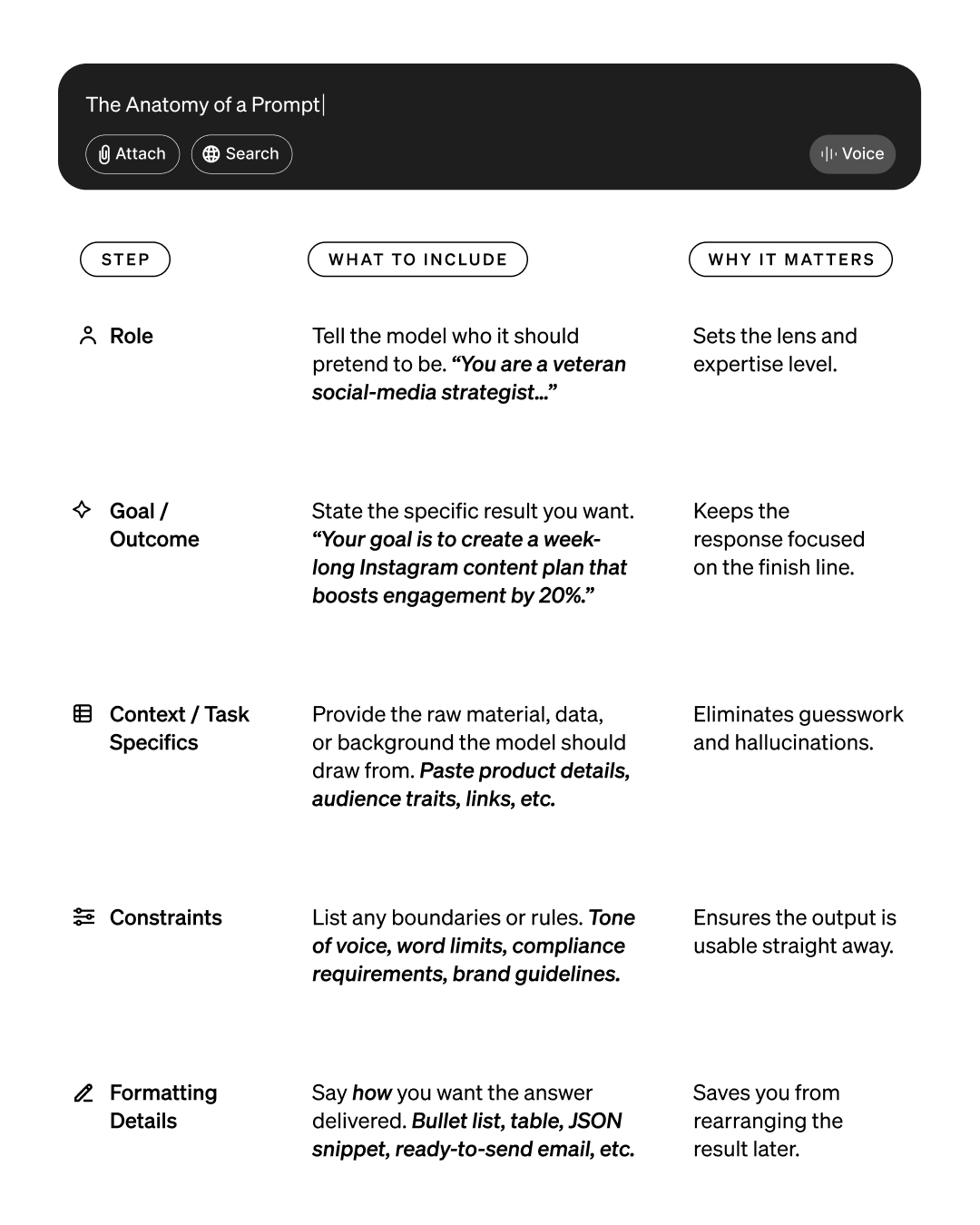
Once you have your results, don’t be afraid to collaborate with your AI tools. If you aren’t completely satisfied with the output, you can ask follow-up questions like: “Can you help me refine this prompt to get a more detailed response?” or “How can I adjust this prompt to ensure the answer is more concise?”
Finally, a truly great AI prompt for business is one you’ll be able to run again and again, generating not only useful information you need in the moment, but also opening up a dialogue with your AI conversation partner that leads to new insights and ideas on how to apply them.
Following these AI prompt-writing principles, along with our examples below, will help you structure your questions to get the best answers possible.
The top 5 ways your business should be using AI today
Now that you know how to structure an AI prompt, let’s put your training into action. Here are the top five ways your business should be using AI today, along with specific tool suggestions and prompt examples to bring them to life.
#1: Generating written or visual content
Why this works: Business owners wear a lot of hats, and generative AI tools can help you by wearing the content creator hat for you. Running prompts like the one below, and then having your AI tool tweak the outputs until you’re happy, can help you quickly transform rough ideas into content. Need a marketing email, a social media caption, or an item description? It’s all possible, in your voice. Business tools like Square Photo Studio, Square Marketing, Canva, Jasper and more have AI layered in to help you generate images from scratch or edit existing ones.
Pro tip:
Bookmark your top-performing emails and social posts and include them as examples in future AI content creation prompts.
Format of this AI prompt:
Role: You are my [ROLE] for [BUSINESS NAME], a [INDUSTRY] brand.
Goal: Draft a [CONTENT TYPE: email / IG caption / blog intro] that will:
- Announce: [OFFER / NEW ITEM / EVENT]
- Speak to: [TARGET AUDIENCE]
- Match our voice: [VOICE]
Context / task specifics:
Must include: [KEY POINT 1], [KEY POINT 2], CTA “[CALL-TO-ACTION]”.
Constraints & formatting details:
Keep it under [LENGTH] and suggest 3 alt headlines.
Here’s an example of how that prompt might look if you’re crafting an email campaign:
Role: You are my [email-marketer] for [Sally’s Gourmet Chocolates], a [Food & Beverage Industry] brand.
Goal: Draft a professional marketing email that will:
- Announce: [launch of new line of seasonal chocolates]
- Speak to: [customers who have purchased at least once in the last year]
- Match our voice: [warm and witty]
Context / task specifics:
- [order before 1st December in order to receive your gifts on time]
- [buy two chocolates, get one free]
- [makes the perfect gift for the people in your life you don’t know what to buy for]
- [include call to action: order now]
Constraints:
- Attention-grabbing subject line (plus 3 alternate subject lines)
- Greeting that feels on-brand
- Body paragraphs (keep total length under 120 words)
- Strong closing that reinforces the CTA
Formatting details:
Return the finished email followed by the three alt subject lines and three alt headlines.
#2: Keeping up with your industry
Business owners are always on the lookout for new ideas and revenue streams. There’s just not much time to find them. The AI prompt below lets you skip the line to learn about the latest trends in your industry and how you might act on them. You can customise this prompt far beyond what we’re suggesting, asking it for news on industry niches or scan for updates about your specific competitors. You can even use NotebookLM to summarise the output in podcast format.
Format of this AI prompt:
Role: You are a senior industry analyst specialising in [your industry].
Goal / outcome: Produce a monthly report that surfaces the 5–7 most important news items and emerging trends owners in [your industry] should act on.
Context / task specifics:
- Time-frame: [dates you’d like to review]
- Primary market: [country / city / town]
- Company profile: [type of business, number of employees]
- Competitors of interest: [list key competitors, if any]
Constraints: Include any criteria on the sources used and any other boundaries for the AI tool.
Formatting details: Include exactly how you’d like the results to be returned so you can analyse and share them quickly.
Here’s an example of how that prompt might look if you’re a retailer:
Role: You are a senior industry analyst specialising in [retail apparel].
Goal / outcome: Produce a monthly report that surfaces the 5–7 most important news items and emerging trends owners in [the apparel industry] should act on.
Context / task specifics:
- Time-frame: [01/06/2026-30/06/2026]
- Primary market: [Shoreditch, London]
- Company profile: [omnichannel, two location business, <50 employees]
- Competitors of interest: [AIDA, Goodhood, TOAST]
Constraints:
- Use only reputable, verifiable sources; include live URLs.
- Clearly separate facts from speculation.
- Rate the impact of each item (Low / Medium / High).
- Focus on practical implications for small businesses.
Formatting details:
- Executive summary (≈ 150 words)
- Table: each row = one news item → columns for *Headline* • *2–3-sentence summary* • *Impact rating* • *Why it matters* • Source link
- Action checklist (3-5 bullet points)
Where to use this prompt: AI tools like ChatGPT or Claude work here, too. Or you could use a tool like NotebookLM to summarise in audio format.
#3: Researching your next business move
Generative AI has changed how we all search online forever. Need a specific answer to your question? You’re probably going to ask your preferred generative AI tool instead of Googling it. While this can be a good resource when you’re curious, businesses can use a more detailed version of this tactic to come up with new product or location ideas, create an employee training manual, or compare different types of business software.
Say you’re a nail salon owner, and you’re considering launching your own brand of beauty products to stand out from local competitors and generate more revenue. Here’s how you might engineer your prompt for the best possible outcome.
Format of this AI prompt:
Role: You are a [ROLE] in [INDUSTRY].
Goal / outcome: Deliver [CONTENT TYPE] that will align with [GOAL] and achieve [DESIRED RESULT].
Context / task specifics:
Incorporate the following information into the results:
- [BUSINESS WEBSITE’S URL]
- [TARGET CLIENTELE]
- [TOP SERVICES]
- [CURRENT RETAIL PRODUCTS + BEST SELLERS]
- [AVERAGE ORDER VALUE]
- [BRAND PERSONALITY]
- [GOALS]
- [SALES CHANNELS]
Constraints: Include key details like COGS restraints, UK cosmetics regulations, marketing plan budget, etc.
Formatting details: Clarify exactly how you’d like the results returned.
Here’s an example of how that prompt might look:
Role: You’re a beauty-product market strategist.
Goal / outcome: Deliver five private-label product ideas that align with my salon brand and a step-by-step plan to price and market them across in-salon and online channels.
Context / task specifics:
- Salon website: [www.marthasbeautysalon.com]
- Target clientele: [young professionals]
- Top services: [hair cuts, hair highlights, hair extensions]
- Current retail products + best-sellers: [rosemary shampoo, rosemary conditioner, leave-in conditioner]
- Average spend per visit: [£275 value]
- Brand personality: [fun & edgy]
- Goals: [increase profit margins, build loyalty]
- Sales channels: [in-store, e-commerce, social]
Constraints:
- Ideas must complement existing services and aesthetic.
- Keep COGS under [25%] of target retail price.
- Comply with UK cosmetics regulations (and product safety requirements)..
- Marketing plan must include one low-budget tactic and one partnership idea.
Formatting details:
Return two sections:
1. “Product Ideas” → table with *Idea* • *Product fit rationale* • *Estimated retail price* • *Projected margin*.
2. “Launch Plan” → numbered roadmap (concept → sourcing → pricing → rollout → promotion).
#4: Providing better customer support
Growth comes with tradeoffs. For many business owners, this means spreading themselves too thin while trying to maintain the personal touches that make their operations shine. While it’s not yet perfect, AI can solve for this, too. While you may worry about AI-powered customer support tools taking away from your personalised services, you’ll find today’s chat assistants can often allow customers to get answers to basic questions quickly or complete simple tasks 24/7, with clear escalation points to speak with a staff member during business hours for help with more complex needs. For example, Square Assistant is effective in answering basic questions or helping your clients book an appointment when you’re busy with other customers.
Pro tip:
While chat assistants can range from basic to complex, including walking a customer through the entire purchase experience or untangling a customer service issue, it’s important to have clear escalation points where customers can ask to speak with a human.
#5: Deepening insights to make better business decisions
There’s no replacement for a thought partner who knows your business well. Now, AI built into your business’s dashboards can fill a lot of that function – and it won’t even ask you for equity. Since Square AI has access to your business’ data, asking it simple questions can get you instant answers and lead to better business decisions. Gabriel Larraz, co-founder of Broken Eggs says “Previously, I’d pull reports from Square, wrangle them in a spreadsheet, and manually match them with deputy labour costs. It would take 30–60 minutes easily to get a usable heatmap. Square AI gets me there in five minutes, so we can keep staffing tight and stay on top of labour costs week to week.”
Prompts: You don’t need to give Square AI as detailed prompt, as it is connected to your day-to-day business data and has some context on how your business runs. Talk to Square AI like you would talk to someone who is watching every transaction taking place in your business. That means you can start effective conversations by asking questions like:
- What days of the week do I get the most first-time customers?
- How do my labour costs compare to this month last year?
- What were my worst-selling items over the last quarter?
Think of the questions you ask Square AI as a jumping off points as opposed to final destinations. These questions could not only return surprising answers, but also allow you to dig deeper via follow-ups like: “What items are first-time customers purchasing on these days?” or “How would it affect my profits if I discontinued those low-selling items?”
Square AI is available in open beta to all Square owner accounts in the UK., and currently supports questions about sales, transactions, staff, customers, and general help topics. We’re continuing to develop Square AI tools in close collaboration with businesses that run on Square to ensure new features are launched responsibly to best meet our community’s needs.