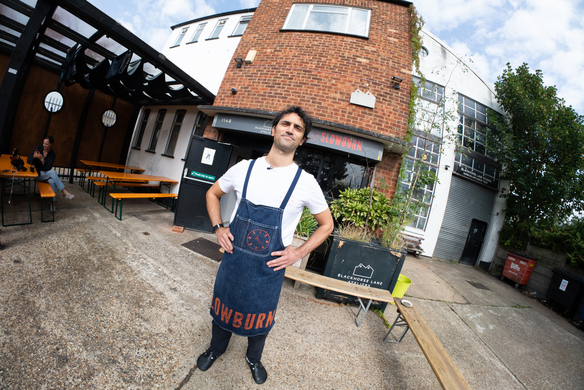


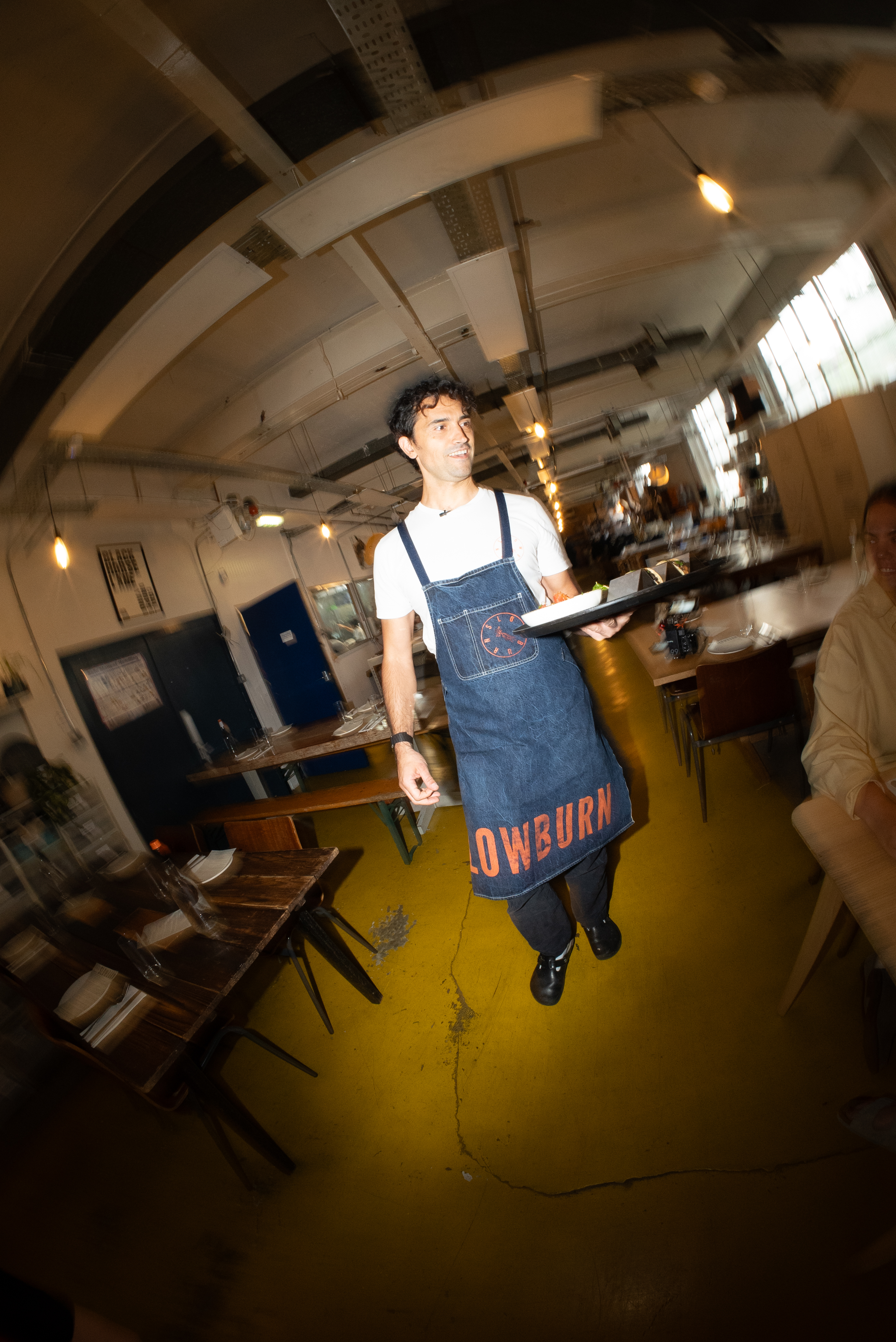
SlowBurn doesn’t look like any other restaurant in London, because it isn’t. Tucked inside a denim workshop in Walthamstow, the restaurant shares the industrial space with sewing machines, rolls of fabric and the city’s only craft jeans maker, Blackhorse Lane Ateliers. But on weekends, the lights dim and the factory transforms into a dining room where guests gather for founder and head chef Chavdar Todorov’s vegetable-forward plates.

Open from Friday through Sunday, SlowBurn was recently named one of The Good Food Guide’s 100 Best Local Restaurants. But its path here has been anything but conventional. Chavdar originally set out to launch a smoked meat takeaway, but changed course two weeks into developing the menu: “I was like: you know what, if this is going to go somewhere, I’m not going to be comfortable with a meat-heavy menu,” he says. “This is not where the world is going. So I flipped it around and started focusing on vegetables.”
That decision defined SlowBurn’s identity. The restaurant champions vegetables, putting them at the centre of the menu while offering meat and fish as complements rather than the main event. Around half of the menu is vegan and changes with the seasons, but a few dishes have become permanent favourites – like the black bean gyoza tacos with coriander salsa and the cauliflower fritters – which regulars insist always stay on the menu. Talking of regulars, couples fill the space on Friday and Saturday nights, while Sundays draw families with children, dogs and buggies for a more relaxed vibe. This local community feel extends to the partnership with Blackhorse Lane Ateliers. Chavdar feeds the factory staff every Friday, and in return, they make aprons for the restaurant team.

Balancing experimentation with operations
“I want people to feel like they’re at home when they visit,” says Chavdar, “even though they’re surrounded by industrial washing machines.” That welcoming atmosphere has been built on a willingness to experiment and stay flexible – whether with the menu, the space or the overall dining experience. “The business has changed at least 10 times since I started it,” he explains. “We adapt all the time with the space and with the offering.”
This experimental mindset has helped SlowBurn find its niche, but Chavdar soon realised that, without systems in place, the restaurant risked being held back by its own growth. “The best advice I’ve received is to set up systems from the beginning and keep an eye on the numbers from day one,” he reflects.
So the challenge wasn’t about solving a single problem – it was about creating a foundation that could bring order to the chaos, support daily operations and still leave room for SlowBurn to evolve in new directions.
Square becomes an important part of the team
Almost from the outset of offering sit-down dining, SlowBurn chose Square for Restaurants and the decision to adopt this point-of-sale (POS) system was guided by two main needs: ease of use and the ability to centralise systems. “We chose Square because it’s user-friendly… It’s like an all-in-one kind of system,” says Chavdar.

Today, SlowBurn runs its operations with Square Stand, Square Terminal, Square Reader, and the new Square Handheld. The latter, in particular, has been a hit with staff. “All the front-of-house members love Square. It’s really easy to use, especially with the new handheld devices. They’re really compact with a large screen. Really intuitive. Love it.”
Here’s how Square helps SlowBurn maintain a dynamic approach to running a restaurant:
Quickly making menu changes
To ensure newcomers and regulars alike find something that catches their attention, SlowBurn regularly updates its menu. With Square, those changes are seamless. “We change the menu here often, almost every week, sometimes twice a week. And it’s really easy to update everything with quantities. It [supports] really good communication between front of house and back of house.”
Getting staffing and sales insights
By using Square for both rota management and reporting, SlowBurn gains a clear picture of performance. “Square really helps us have an overview of sales. And because we do the rota with Square, we can see the percentage of labour [costs] versus sales.” This visibility allows SlowBurn to adjust staffing levels, refine the menu based on what’s selling and plan service around the busiest times.
Integrating with other critical tools
“The other good thing about Square is that it integrates well with the other systems we use, like our reservation platform,” says Chavdar. “We’re really happy that Square connects seamlessly with SevenRooms. From the start, we wanted to have as few different systems as possible and for them to work together.” It’s simple: linking reservations, point-of-sale and reporting in one connected ecosystem boosts restaurant efficiency and keeps operations streamlined.
Even customer-facing promotions have been simple to set up with Square. When SlowBurn wanted to experiment with a Sunday roast offer, their account manager, Kitty Davies, helped make it happen quickly. “The Square ecosystem is intuitive. Really doesn’t take much time to get used to, so people get up to speed with it really quickly.”

An empowered team and enhanced service
By simplifying the back office, Square has freed up Chavdar and his team to focus on the food and, just as importantly, the holistic experience they offer, which is aided by tools that keep operations running in the background. Reporting and rota management provide clarity that helps optimise operations, easy menu updates make seasonal creativity possible and handheld devices keep service smooth. And the benefits extend beyond customers – staff feel supported and engaged, too. “I’m proud of how people feel when they work here. We have people reaching out, wanting to work with us, and people staying here for three plus years, which is rare in hospitality,” says Chavdar.
Looking ahead, Chavdar feels confident that Square will continue to grow alongside SlowBurn. “The reporting that Square does really helps us with the decisions we make. They’re quite detailed, and we often make changes based on what we see.”
It’s just one way that Square’s tools allow the team to maintain flexibility without sacrificing control – something that’s crucial for a business that wants to continually adapt and meet customer needs. “It really helps us run the business. We use Square to take orders. We use Square to do our rota. We use Square for reporting. Everything goes to Square, really.”