

Table of contents
The UK food truck industry represents a delicious opportunity for budding food entrepreneurs. The total annual revenue of the UK street food market is expected to reach £1.4 billion by 2028, and, compared with other hospitality businesses, food trucks carry lower startup costs.
So, if you’re eager to turn your culinary talents into profit, this guide will give you all the information you need to ideate, launch, and grow a thriving new food truck business.
Create a food truck business plan
Your business plan is the north star for your food truck business. It’s a roadmap that incorporates your vision, market research, growth plan and all logistical practicalities, helping you stay focused when launching your new business (and for years after).
Choose a concept
Start by analysing local food trends and gaps in the market, then blend your culinary passion with a unique twist, whether that’s fusion flavours or a speciality dish, to craft a concept that stands out in your local marketplace. For example, Grounded Manchester built a loyal following with their menu of speciality coffee, ice cream and baked goods.
Most successful food trucks choose concepts that are either very niche, like a unique take on a common cuisine, or something completely new.
Here’s how to develop a standout concept:
- Choose a niche that you’re passionate about. For example, are you passionate about ‘British classics’ like Cornish pasties, pork pies and Scotch eggs, or speciality sandwiches like gourmet cheese toasties or loaded bacon butties?
- Leverage your strengths. If you’re skilled at plant-based recipes, focus on vegan options; if you love baking, consider artisanal pastries or dessert hybrids.
- Add a twist to stand out. Examples include fusion flavours (e.g., sushi burritos), premium ingredients (e.g., wagyu sliders), or a signature sauce.
Analyse your target market
Once you’ve picked your underlying concept, it’s time to validate and refine it by analysing your target market.
It’s important to describe your process for market research in your business plan, especially if you’re seeking funding. Banks and investors want to know you’ve performed due diligence through methods like surveys, competitor analysis, and analysis of local food trends.
Here’s how to map the nuances of your target market:
- Define the demographics of your target customers in terms of age, income, and location.
- Measure demand by combining surveys (tools like SmartSurvey are helpful), interviews and analysis of social media trends.
- Use review platforms (Yelp, Google Reviews, etc.) to analyse what customers like or dislike about existing food trucks.
- Align with customer preferences by testing concepts through pop-ups or in-event surveys to ensure demand.
This process follows a tested framework. First, you define your target customers. You then check for demand through quantitative methods and develop your understanding by looking at qualitative reviews. Finally, you test your concept by creating a minimum viable product (MVP) in the form of a pop-up truck.
Study your competitors
It’s important that your business plan also identifies direct competitors, which might include other food trucks, nearby restaurants, or fast-food chains.
The aim here is to effectively differentiate your truck from competitors. Will you offer a unique menu, faster service, premium ingredients, or something else?
Here’s a simple four-step competitor research process:
- Visit local food truck events and festivals to observe trending cuisines, underserved food types, pricing, and crowd engagement.
- Follow local food trucks on social media to track their locations, menu changes, and customer interactions.
- Identify underserved locations and times by mapping out existing offerings and finding gaps you might fill with your concept.
- Network with local food truck owners or join industry groups to gain insights into operational challenges and success tips.
Competitor analysis comes after you’ve validated your initial concept. It’s about tweaking and tailoring your offering so that it will truly stand out in a crowded market.
Conduct a SWOT analysis
Once you have a differentiated concept, a SWOT analysis is the final test of feasibility. It is a means of comparing opportunities and risks before you commit resources and enter the market.
Here’s what a sample SWOT analysis looks like, with examples:
- Strengths: Low startup cost, strong differentiation, proven demand
- Weaknesses: Limited space, weather-dependent, seasonal
- Opportunities: Growing demand for affordable luxury food, social media marketing opportunities, low-cost event slots
- Threats: Significant competition, complex permits, rising cost of food
If, on balance, the strengths and opportunities outweigh the weaknesses and threats, you may have a successful concept and should start getting a handle on potential startup and operating costs.
Identify startup and operating costs
Your financial plan should include all of the following startup costs:
- Equipment
- Permits
- Licences
- Truck purchase or hire
- Branding
- Initial inventory
Alongside the following operating costs:
- Fuel
- Maintenance
- Ingredients
- Labour
- Insurance
- Marketing
- Event costs
You should also outline a pricing strategy, which will detail your plan for competitive yet profitable pricing based on food costs and local demand. Finally, include revenue projections that describe your estimated daily or weekly sales, break-even analysis, and profit margins.
Create a menu
Your menu brings together all your previous work. You have a differentiated and tested concept, an understanding of your target market, and an overview of budget and costs. Now it’s time to fine-tune your product.
Follow these steps to create your menu:
- Use your concept as the foundation to ensure consistency across your menu.
- Set prices based on your demographic research (items need to be affordable), cost analysis, and existing price points.
- Include signature items that highlight your differences compared to competitors.
- Balance complex menu items and components with simpler ones so that preparation doesn’t become overwhelming.
- Test menu items – focusing on portion sizes and margins – with a soft launch.
Obtain licences and permits
To legally operate your food truck, you need to obtain a mix of permits, most of which are processed at the council level.
Here’s an overview of the licences and permits new food trucks will need.
- Register with your local council 28 days prior to beginning trading.
- A street trading licence and/or street trader consent which allows you to park in designated areas. Licences are required for some areas (typically high-traffic static locations), while only consent is required for others (usually streets with lower footfall designated for temporary use). You may need only one of the two or both, depending on where you want to trade. It varies from location to location, so check with your local council.
- Commercial vehicle insurance, public liability insurance, product liability insurance, and employer’s liability insurance.
- Safety documentation for all cooking equipment.
- Level 2 hygiene certificate for you and your staff (explained in more detail below).
Note: A commercial driving licence is not usually required to drive a food truck in the UK. If you’re converting a large vehicle, like a double-decker bus, check if your current licence covers you to drive it.
Purchase food truck equipment
Buying a truck and cooking essentials accounts for a major portion of your food truck startup costs.
Here are some tips for what you’ll need and how to reduce the cost of starting your food truck:
- Consider renting a van to reduce your upfront expenses and test the viability of your business. Another option is to purchase a trailer. While it’s less mobile, it’s a less costly way to start a food truck business.
- Buying a vehicle offers more control and long-term value, but it’s not the best option for everyone, especially if you’re trying a startup on a budget. That said, while vans will depreciate, they do hold their value better than cars.
- Plan for the purchase of key food truck equipment like a fridge, oven, grill, fryer, sinks, generator, food truck point-of-sale (POS) system, and ventilation. Look for low-to-moderately-used options on kitchen equipment to save money.
- Invest in branding by putting a custom wrap and signage on your food truck – this is essential for having a visible, memorable identity, so don’t overlook this cost.
Rented vs. used food truck equipment
Acquiring your food truck will almost certainly be your largest startup cost. However, your truck doesn’t need to be prohibitively expensive, especially if you opt for a used model.
If you do decide to go down the used route, you can either lease or buy:
- Buying a used food truck: Used food trucks can be found on marketplace listings and specialist websites. They will come partially or fully outfitted, but may require repairs or other updates to meet regulations. These will be more affordable than a brand-new truck, but make sure to have your potential purchase professionally inspected before making a final decision.
- Renting a food truck: Renting can be the most affordable and quickest option. If startup funds are tight, renting a food truck before you buy can be a useful way to test your concept. However, you won’t own the truck, so customisation and branding options can be more limited than renting or buying.
Purchasing vs building a food truck
If you prefer to buy a new truck, you can opt for either a standard model or a custom-built one. Prices tend to start at around £10k (based on current listings on popular marketplaces) and increase depending on the number of individual specifications.
If you’re unsure of the layout you want, UK food truck manufacturers will be familiar with the regulations required for a food truck to operate legally and will also have examples of existing successful food truck layouts.
A fully-customised food truck is the most expensive option and can take several months, but your equipment will be brand new and organised around your specific needs.

Food safety considerations for food trucks
UK food trucks are subject to Food Standards Agency rules and inspections (just like any other food business), so it’s essential that you obtain all relevant certifications and maintain ongoing standards.
Here’s a food safety checklist for UK trucks:
- General compliance with Food Standards Agency guidelines
- Level 2 food hygiene training for all staff
- Hazard Analysis and Critical Control Point (HACCP) system
- Handwashing and cleaning facilities
- Allergens management and labelling
- Handwashing and cleaning stations
- Compliant waste disposal practices
Expect an inspection within six months of opening, where you will be awarded a food hygiene rating of between 0 to 5. This can have a significant effect on how customers perceive your brand, so don’t overlook safety practices.
Managing food truck operations
Outside of preparation, serving and cleanup, your daily operations will generally fall into one of three categories: taking payments, managing and tracking inventory, and managing employees.
The good news is that most tasks can be streamlined (and even fully automated) with the right tech.
Taking payments at a food truck
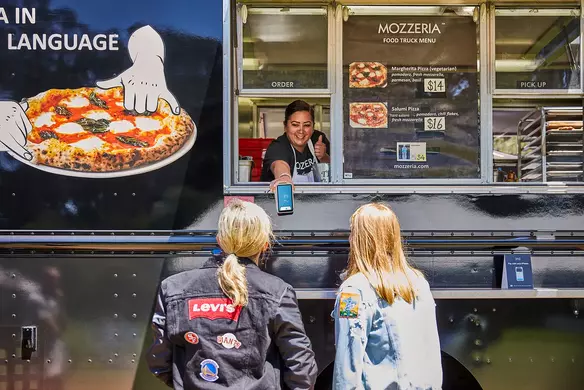
To ensure successful and seamless transactions for customers, invest in a point of sale system (POS) (and supplementary accessories) that is fast, reliable and integrates seamlessly with your backend.
Since you’ll have rush hours where you need to take payments quickly, and given that paying by card is the norm nowadays, a well-chosen POS is non-negotiable. The key is to make sure your POS system can accept multiple payment types, like credit cards, contactless payments, and mobile wallets.
POS for food trucks checklist
Here’s a checklist for picking a point of sale system (POS):
- Mobile-friendly: Select a food truck POS system specifically designed for food trucks’ small spaces and on-the-go operations.
- Offline capability: Ensure the POS works without internet to avoid service interruptions.
- Ease of use: Ensure the system is intuitive and quick to learn for fast-paced environments.
- Order customisation: Confirm that the POS has the ability to handle modifiers, combos, and special requests easily.
- Speed and reliability: Select a POS system that offers fast checkout to keep lines moving during busy hours.
- Multi-location support: Plan for future expansion with a system that will operate at multiple sites or events.
- Loyalty and promotions: Check for built-in tools for discounts and loyalty programmes, or email marketing.
- Integration with accounting or inventory tools: Confirm the POS can help you streamline backend operations and HMRC reporting tasks.
- Cost and fees: Be mindful of upfront hardware costs, monthly fees, and transaction charges.
Inventory tracking checklist
Here’s a rundown of what to look for when picking an inventory tracking app for your food truck:
- Real-time tracking: Look for an option that lets you track ingredients and menu items in real time.
- Ease of use: Staff should be able to learn how to use your POS quickly with a minimum of training, especially if you plan to hire short-term or seasonal workers.
- Reporting: Evaluate the system’s capability to access and report on sales data, peak hours, and customer trends to help you improve operations. Square POS system, for example, has inventory management and reporting capabilities that can help you run and grow your business.
- Ingredient-level tracking: Inventory tracking software designed for the food industry is able to track stock at the ingredient level.
- Customer support: Your time is best spent running your business, not trying to remedy technical issues. A responsive support team, available in your business hours, is a must.
Employee management checklist
Check for all of the following factors when picking an employee management app:
- Simple time tracking: Employees should be able to clock in and out quickly.
- Payroll integration: Your chosen app should sync with your accounting and payroll software.
- Performance analytics: These give you insight into where employees are underperforming and where you can make efficiency gains.
- Self-service for employees: An employee portal will allow staff to track their own pay and check their schedules.
Promote your food truck
Your business plan should also include your strategy for promoting your food truck. Once you’ve come up with a van design that captures attention on the street and speaks to your concept, you need to get the word out. Here are some ideas to get you started.
Leverage user-generated content (UGC)
One of your best marketing tools is already at the heart of your business: your food. Having a visual feast of items on your menu helps your business generate buzz online. The goal is for people to share photos of your food on social media and go viral – that drives business to your truck. You can encourage social sharing by offering discounts, free add-ons, or just asking your customers to share as you serve them.
Prioritise social media
Social media is also an excellent way to keep your followers informed of your location and stay in touch with fans. An Instagram account and TikTok account let you showcase your menu offerings (as well as any specials you’d like to share with customers) white building your following.
Build a website
To maximise exposure, you should create a website that mirrors the vibe of your business. You can build it yourself with an online tool or outsource the website for a more professional feel.
Also consider a plan for online orders: 78% of restaurant leaders report that online checkout is a main revenue driver for their business, according to Square 2025 Future of Restaurants data.
In the same report, 72% of consumers said they would likely engage with an informative website. Your website is your digital storefront and an opportunity to entice potential customers. It should include all information they might need – including opening times, location, and, of course, a detailed menu with pricing.
Set up review pages
Make sure you set up profiles on online review directories like Yell and OpenTable. These reviews can drive significant foot traffic from local searchers. To ensure customers can leave you a Google review (and that you’re able to respond), create a free Google Business Profile.
When you serve customers, encourage them to leave you a review on review platforms to help build a positive brand.
Invest time in PR
Another way to generate buzz is by reaching out to food bloggers. Find food bloggers with large followings in your area, and ask them to visit your truck. Consider comping the blogger’s meal in exchange for them posting about your food.
Don’t forget about promotions and loyalty programmes
Offering coupons or discounts for your grand opening, or featuring special offers on different days, can also help drive business.
Loyalty programmes are another powerful tool that benefits both customers and business owners. They offer customers exclusive deals and discounts on their favourite items, so working toward a unique reward or perk may be just the incentive a customer needs to pick your food truck over any others parked nearby.
Plus, Square data shows that customers enrolled in a loyalty programme spend 53% more and visit 40% more often.

How to start a food truck FAQs
How much do food trucks make?
A successful UK food truck will turn over around £100,000, and you can expect a 25% to 35% profit margin. That said, earnings do depend significantly on location, marketing, and the good ol’ British weather.
What salary do you pay yourself as a food truck owner?
Most truck owners pay through a mix of a salary and dividends. It’s typical for owners to pay themselves up to 50% of profits along with a base salary.
What are the benefits of owning a food truck?
There are three main benefits of owning a food truck: comparatively low startup costs, flexibility in pursuing customers (you can travel to where the greatest footfall is), and a growing demand for street food in the UK.
What are the disadvantages of owning a food truck?
The main disadvantages of owning a food truck are the complex body of rules and regulations that owners have to abide by, dependence on weather, and a cap on growth (unless you buy more vans).
How much does it cost to start a food truck?
Expect to invest around £20,000 as a minimum to launch a fully operational food truck business (including your van, stock, permits, marketing, and technology). If you opt for a fully customised truck, these costs will likely more than double.