




Table of contents
You don’t need to know the ins and outs of credit card processing to own and operate a business. But it definitely helps to get the lay of the land. In this guide, we walk you through everything you want to know about credit card processing — and how to select the best option for your business.
What is credit card processing?
Taking a credit card payment may seem simple enough. A customer hands over a card, you process it, and with Square, the money usually lands in your account within one to two days. But under the hood, there’s a lot more going on. From the time you insert, tap or swipe the card until the time the money is deposited into your bank account, there are a number of different parties involved. And each of them handles a crucial step in the chain of events. Having a general knowledge of how credit card processing works helps you understand where you might incur fees—and informs your decision about what credit card processing system makes the most sense for your business.

The parties involved in credit card processing
Let’s say you go into a place called Cup of Joe Coffee and pay for a latte. Here are the official names of the players involved in the transaction:
- The cardholder: This is the person with the credit card (aka you)
- The credit card: That rectangular piece of plastic with your payment credentials on it (e.g., Signature RBC Rewards card)
- The merchant: The business accepting your credit card as payment for goods or services (Cup of Joe Coffee)
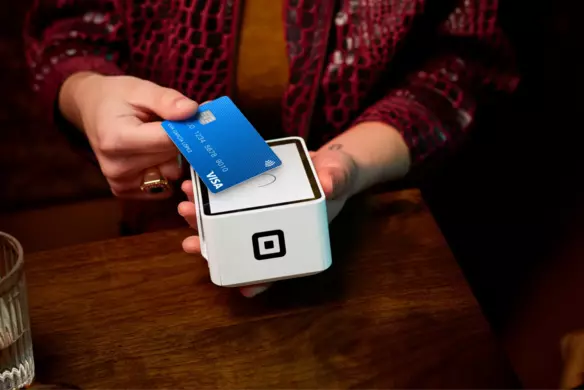
- The point-of-sale system: The interface used by the merchant to accept the credit card payment (e.g., a Square Reader or Stand)
Now let’s zoom in for a second. There are a few additional parties represented on the credit card and in what’s happening during the transaction itself. They are:
- The issuing bank
- The acquiring bank
- The merchant services provider
There are a number of different parties involved in processing credit card payments.
Let’s look at each of these:
What is an issuing bank?
The issuing bank is the financial institution that provides you with your credit card and accompanying line of credit. It’s basically your credit card company. Issuing banks act as middlemen between you and the credit card networks by issuing contracts with cardholders for the terms of the repayment of transactions. For example, your issuing bank could be RBC.
What is an acquiring bank?
The acquiring bank (also known as a merchant bank or acquirer) is the bank that sends the transactions to the network, which then passes it on to the issuing bank.
What is a merchant services provider?
A merchant services provider is an entity that allows businesses to accept payments by credit card, debit card and also NFC mobile wallet (like Apple Pay and Google Pay). A merchant services account is established with an organization that has relationships with the issuing and acquiring banks. Your merchant services provider allows the processing of electronic payments when your customers want to pay for things.
What is a payments gateway?
Say Cup of Joe Coffee had an online store to sell things like T-shirts and mugs. Something called a payments gateway would be involved in processing those online credit card transactions. A payments gateway facilitates the transfer of information between a payment portal (like a business’s website) and the acquiring bank. It encrypts sensitive information like card numbers to make sure everything is secure throughout the process.
Merchant credit card processing
How do you get a merchant services account?
Conventionally, if you wanted to start processing credit cards, you’d apply for a merchant services account at a bank, which can be a cumbersome process. After you were approved, you would then associate your point-of-sale system with your merchant account and could start accepting credit cards.
But with Square, things work a little differently. Square itself has a merchant services account with acquiring banks. We essentially act as one giant merchant services account for all businesses that use Square.
What is a high-risk merchant services account?
In the credit card processing world, some types of businesses may be considered “high risk.” High-risk merchant services accounts can have steeper fees and stricter terms. Institutions may also deny high-risk merchants an account.
There’s no hard rule, but certain types of businesses tend to be flagged as high-risk merchants more than others. These can include businesses that sell goods or services that border on illegal, buyers’ or membership clubs, credit counselling or repair services and businesses that engage in questionable marketing tactics. Read the Square user agreement and terms of service for more information.
How does credit card processing work?
Now that we’ve gone through all the parties involved in credit card processing, we’ll walk through how everything actually works. Let’s go back to Cup of Joe Coffee. You hand the barista your card and she processes it. What happens next?
Here is how a credit card is processed with Square:
Authorization
When a merchant taps a customer’s card, the request is submitted to Square. We then send the transaction to the acquiring bank, which then sends it to the issuing bank for authorization. The issuing bank is checking for sufficient funds. It is also running the transaction through fraud models to determine if the transaction is safe (to protect the cardholder and the issuing bank).
Batching
This is the settlement stage, i.e., how the money from a transaction is sent to the acquirer to begin the process of depositing it into the merchant’s account. It’s called batching because payments are sent in a large group.
Funding (aka settlement)
The funding (or settlement) step is when businesses get the money from a credit card sale deposited into their account. Square’s deposit schedule is usually within one to two business days.

Credit card processing fees
Many companies have a ton of hidden fees when it comes to credit card processing. These can include transactional fees (like interchange reimbursement fees and assessments), flat fees (like PCI fees, annual fees, early termination fees and monthly minimum fees) and incidental fees (like chargebacks or verification services). Square, on the other hand, has none of these.
Choose your credit card processing solution carefully, some companies can have hidden fees.
Square’s pricing is simple—there are no hidden fees. It’s just 2.5% per insert or tap for all major credit cards including AMEX, and 0.75% + 7c per INTERAC payment. These fees apply to all business types, including nonprofit organizations.
Accepting credit cards
What is a credit card machine?
You need to get a new piece of technology to process credit cards. A credit card machine, or a point of sale (POS), is a device that interfaces with payment cards to make electronic fund transfers. Newer point-of-sale systems (like Square Reader 2nd generation) also accept mobile NFC payments like Apple Pay and Google Pay.
Credit card machine prices
Some credit card machines can costs hundreds of dollars. Square’s latest credit card reader, on the other hand, costs just $69. The Square Reader (2nd generation) accepts EMV chip cards and NFC payments.
Mobile credit card machines
A lot of point-of-sale systems are big and clunky. Square’s POS products are sleek and completely mobile. They’re designed to look great on your countertop when you’re selling at your brick-and-mortar shop, and fit in your pocket if you’re selling on the go.
How to set up credit card processing for your small business
If you’re new to all this, or are just starting your first business, getting set up to process credit cards may seem daunting. Luckily, that doesn’t have to be the case. Nowadays, with tools like Square, it’s very easy to get up and running with accepting credit cards at your small business. In fact, all you need is your mobile device. Square works directly with the device you already have to accept credit card payments and, with our new reader, NFC payments like Apple Pay.
Here’s a step-by-step guide for how to start accepting credit card payments:
- Order the Square Reader (2nd generation) and tell us where to mail it.
- Create your free Square account.
- Download the free Square app and link your bank account for fast deposits.
- Connect the Square reader to your smartphone or tablet and start taking payments.
What other types of payments should you accept?
In addition to EMV chip cards, it’s a good idea to also accept NFC mobile payments like Apple Pay and Google Pay. These new payment methods are just as secure as EMV but are a far better customer experience. According to the Square Future of Commerce report, 58% of Canadian consumers wouldn’t be likely to return to a restaurant, retailer, beauty salon or spa that doesn’t offer a convenient way to pay. Whereas EMV chip cards take several seconds to process (which is actually slower than magstripe cards), NFC mobile payments are instantaneous.

Credit card processing FAQs
What is a credit card processing company?
A credit card processing company like Square handles credit and debit card transactions for businesses. Even though it seems instant, paying for a purchase with a credit card triggers a complex behind-the-scenes process between different financial institutions and parties. Payment processors like Square act as facilitators. They give businesses the tools to accept card payments, like point-of-sale (POS) software and hardware, and they help securely move transaction information along between the parties involved in credit card processing.
How does credit card processing work?
Credit card processing works through several parties to move funds from a buyer’s bank to a seller’s bank, which requires a few different steps and security measures.
When you accept a credit card payment, your payment processor (e.g. Square) encrypts the transaction information and sends it to the card network (e.g., Visa or Mastercard). The card network securely passes the request to the bank that issued the card (e.g., Scotiabank) for authorization.
Before approving the transaction, the issuing bank verifies the card details, and also checks that there are enough funds or credit available to cover the purchase. It then sends the approval back to the payment processor through the card network.
That’s when your payment processor confirms the sale with you. The transaction is officially authorized, but it can take a couple of business days to receive your funds, a process called settlement.
With Square, you can get paid as soon as the next business day, and Square also takes care of PCI DSS compliance for your business, which gives you extra peace of mind when accepting card payments.
How much are credit card processing fees?
Credit card processing fees in Canada can range from 1% to over 3% of a transaction. According to the Retail Council of Canada, 80% of what a business pays on a credit card transaction goes to the cardholder’s bank as an interchange fee, and the rest is split between the card networks and payment processor.
Choosing the right payment processor can make a difference. Square’s pricing is simple, and there are no hidden fees. You pay 2.5% per insert or tap for all major credit cards including Amex, 2.8% + 30c per online transaction and 0.75% + 7c per debit card payment.
How can I accept credit card payments?
To accept credit card payments, you need a POS system that allows you to accept a variety of payment types, both online and in-person. You’ll need POS hardware for in-person transactions, but it can be as simple as a card reader – no traditional cash register required. Square Reader (2nd generation) is just $69 and accepts EMV chip cards, NFC payments and Interac payments.