Use Managerbot to manage business tasks and insights
About Managerbot
Managerbot is an artificial intelligence (AI) business partner that proactively surfaces important insights and suggestions about your business that help avoid challenges and save time. Managerbot tracks key business metrics in one place and can take on routine workflows from start to finish with your edits and approval.
Your Managerbot homepage has the following capabilities:
- Business snapshot: Quickly pull up a view of key performance metrics across sales, orders, items, and customer trends.
- Improvement opportunities: Highlight data-driven signals about your business that may need attention and suggest next steps you can take.
- Data exploration: Go deeper into your data by answering questions about business performance, like filtering and breaking down results by time period, location, channel, items, or customers.
- Scheduling: Analyze staffing and labor costs, and draft team schedules with the right coverage.
- Inventory management: Efficiently receive new inventory. Create a purchase order based on an invoice, packing list, or order confirmation email and automate the updating of inventory counts.
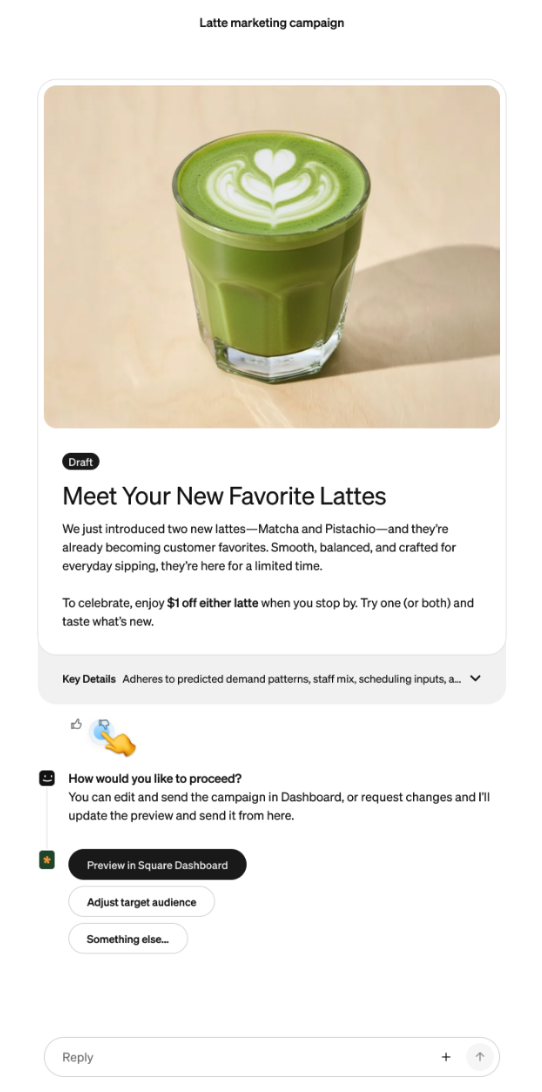
- Marketing: Create and run email campaigns for promotions, items or announcements.
- Catalog and menu management: Bulk update items, menus and flag missing or incomplete information to keep everything accurate and up to date.
If you have other questions about your business data or Square, or if you want Managerbot to complete a specific task for you, just ask it to.
Before you begin
Managerbot currently supports certain data and workflows and can't answer every question or take on every type of action within your Square account.
Managerbot is available on POS as well as the Square Dashboard desktop and mobile app and requires internet access.
If you’re having trouble getting data or performing tasks with Managerbot, try rephrasing your task or insight request to be as specific as possible.
Managerbot is built on large language model (LLM) technology. LLMs make it possible to interact with Managerbot in your own words, but they can make mistakes. Please validate Managerbot’s responses for accuracy, and you can tell Managerbot if you notice information that is inaccurate.
Managerbot exclusively uses data available within your Square account, and publicly available information on the web.
You can undo any action Managerbot takes on your account by simply asking Managerbot to reverse the action. For example, if you used Managerbot to bulk archive duplicate items and want to roll it back, just ask Managerbot to unarchive those items.
The information presented by Managerbot isn’t meant as legal, financial, tax, or employment advice.
If you would like to learn about how Square processes data for use with AI tools, read our Privacy Policy. By using Managerbot, you agree to Square Generative AI Terms.
View and manage business information

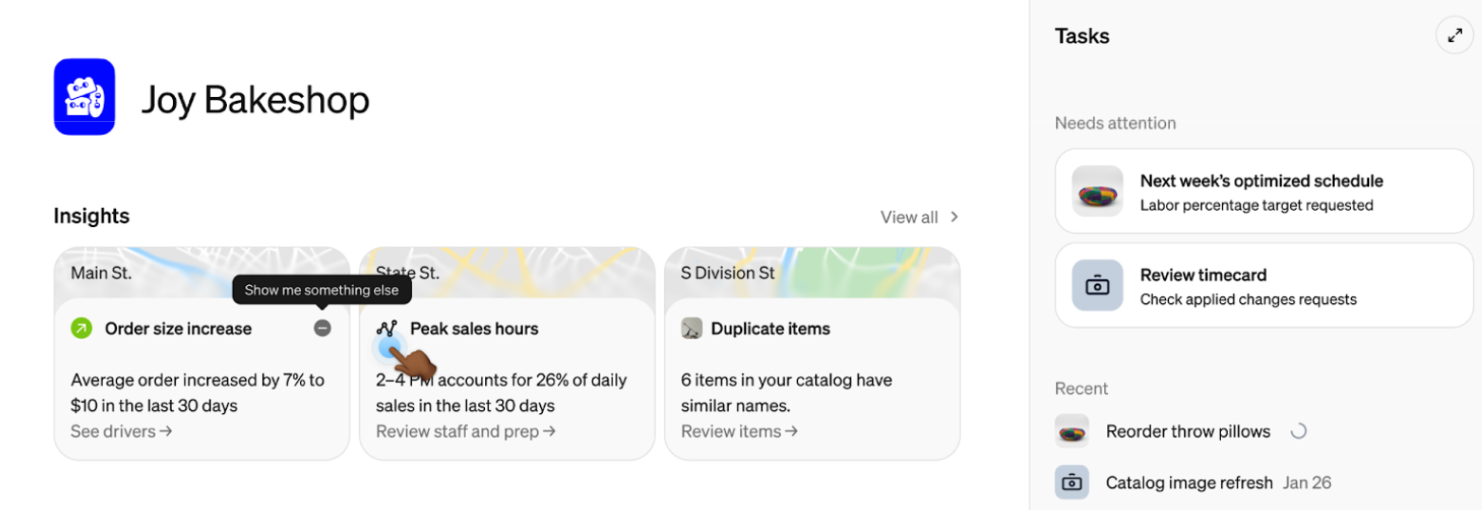
The Pulse tab gives you a real-time snapshot of your business performance. You can view net sales, filter by date range, and see key metrics across sales, orders, items, and customer trends.
The Quick actions tab lets you jump directly into business workflows. Quick actions include:
- Take payments and processing transactions.
- Create and send an invoice to a customer.
- Add a new item to your catalog.
Each business idea is paired with a suggested action, whether that’s going deeper into the data behind the insight, or starting a task that Managerbot can help you complete. Managerbot also provides easy-to-read charts and summaries across different business categories.
If you have other questions about your business data, or about using Square, you can ask Managerbot directly in the chat. Asking Managerbot can be quicker than running a report or setting filters. Simply continue chatting with Managerbot to ask follow-up questions or request specific data visualizations.
To view business ideas:
- Sign in to Square Dashboard. Learn how to sign in to your Square account.
- Click the Managerbot icon in the bottom-left of your screen.
- Scroll to the Ideas section.
- You’ll see different data points about your business. Reference the types of ideas Managerbot can provide at the beginning of this article.
- You can click on each business idea for more information, or click View all to open up a larger list of ideas.
- If there’s a question about your business that isn’t addressed in the ideas that have been generated for you, ask Managerbot your question in the Tasks section.
Managerbot can answer questions about your current Square subscription, including your plan type and features included. When you ask about a feature that requires a different subscription tier, Managerbot will recognize it’s not available on your current plan and can recommend a specific upgrade. Recommendations are personalized to your business based on the features you use and the capabilities you’re asking about.
To manage subscription plans:
- Sign in to Square Dashboard. Learn how to sign in to your Square account.
- From your Square Dashboard homepage, ask Managerbot question such as “What plan am I on?”, “What’s included in my subscription?”, or ask about a feature or capability you’d like to use.
- Managerbot displays your current plan details and included features.
- If the feature requires an upgrade, Managerbot will recommend a plan that includes it and explain the cost and highlight other included features.
- Click Subscribe to go to the subscription page with the recommended plan preselected.
Take account actions with Managerbot
In addition to ideas and guidance, Managerbot can complete routine daily workflows from start to finish with your review and approval. A task can be created as a result from an idea, or you can initiate a task yourself. To set up a task:
Sign into Square Dashboard. Learn how to sign in to your Square account.
Click the Managerbot icon in the bottom-left of your screen.
Within Managerbot, scroll to the Threads section. You can also access your threads at any time from the top navigation.
Within the Threads section, you’ll see suggested prompts that need attention based on your business insights. Click on a thread for more information.
Alternatively, type a desired prompt in the Managerbot chat window. Reference the types of tasks you can ask Managerbot to complete for you at the beginning of this article.
Provide clarification or additional details if prompted to.
Once your task is created, it’ll be listed in the Threads section of Managerbot.
Get support through Managerbot
In addition to business insights and tasks, Managerbot can help answer support questions about your Square account. If Managerbot can't resolve your issue, it can connect you with a live chat agent. A card or button will appear in the chat, select it to opt in. You won't be redirected automatically.
When you connect with a live agent, a summary of your conversation with Managerbot is shared with the agent. This includes your issue, the steps Managerbot already took, and why the handoff was triggered so you don't need to repeat yourself.
Live chat agents may not be available when attempting to contact support. Outside of regular hours, Managerbot will let you know when agents are next available. For more details on all available support options, learn how to get support at Square.